“Every jump is a confession. The Rift hears what you truly intend, not what your flight plan says.”
— Commander Jal Oraz, Celestial Accord Riftgate Security Briefing
Reality is built on a duality: Real-space (Matter, Space, Time) and Rift-space (Intention, Awareness, Devotion). Energy is the only thing that crosses freely between them, allowing thoughts to scar physics and disasters to reshape the psychic ocean that underlies the galaxy.
Nothing truly outruns light in Real-space. Every "FTL" journey is really a cheat: ships slip into Rift-space, where Space is not native and distances are defined by meaning, belief, and emotional currents rather than geometric separation. Interstellar travel, magic, psychic power, angels and demons, and even the fate of souls all tap into this dangerous, psycho-reactive dimension.
The Rift-Space is the backbone of travel, magic, and existential risk in the Starfall Galaxy. Unlike conventional science fiction, nothing outruns the speed of light here—every leap between worlds slips through the unpredictable depth of the Rift, a psycho-reactive dimension that distorts distance, time, and even fate itself. Interstellar travel and spellcasting tap into the same volatile source, making every journey and magical act a gamble. The setting's economy revolves around survival, with time (measured in “Yoms”) acting as coin, and devotion replacing traditional alignment in favor of values inspired by Magic: The Gathering’s Color Pie. Navigating, surviving, and thriving in this galaxy means engaging directly with the peril and wonder that is Rift-Space.
The Galaxy’s Seething Undercurrent
Ask any spacer who has stared out at a Rift storm: the Rift is not a theory. It is the roar beneath the hull, the pressure behind every jump alarm, the taste of metal and lightning in the back of your throat when the ship’s lights flicker.
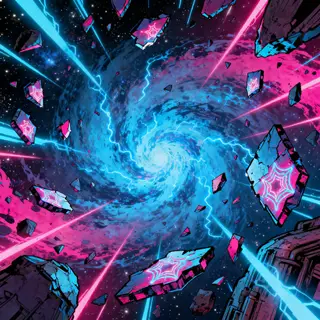
Under the thin skin of Real-space, Rift-space churns like an endless storm of color and concept. Here, the laws of physics falter. Distance lies. Time frays. Thought leaves wake. Every jump a crew makes, every spell a caster hurls, is a hand plunged into that storm, hoping to come back with fingers intact.
Before any written history, it was the Rift that spilled its energy outward and seeded life. Everything that breathes, hungers, and fears in the Starfall Galaxy is born from a spark of that same storm.
Magic, Devotion, and Surviving the Maelstrom
The Rift is the wellspring of all supernatural power. Those who channel its energies risk permanent Rift-Taint—a corruption of body, mind, and machine. The horrors of the Maelstrom, planar bleed, and psychic storms make travel a constant gamble. Magic and advanced technology, in turn, are double-edged: every spell or device may yield boons or trigger wild mutagenic effects. All devotion, whether faith, ideology, or raw emotion, is measured on a spectrum, tying a character’s powers and values to their unique mix of devotion.
Real-Space: The Measured Surface
To most people, Real-space is all that matters. Ships have hulls and drives. Worlds have gravity and weather. Trade routes sprawl across the star maps of the Inner and Outer Spheres. Space can be crossed with thrust and patience; time can be sliced into Yoms and Pulses.
Matter is what your ship is made of.
Space is the void you cross.
Time is the beat of Metronomes and the ticking Yom in your survival kit.
Chronologist Guilds keep that beat. Their Metronomes broadcast a Standard Cycle across the void, holding back the chaos of drift so that fleets arrive on time and Dei Survival Packs last exactly as long as promised.
Rift-Space: Intention, Awareness, Devotion
Drop below the skin of the galaxy and the axes change.
Intention: what you truly aim to do, even when you lie about it.
Awareness: what you know, ignore, misremember, or refuse to see.
Devotion: what you belong to—ideals, factions, obsessions—mapped in terms of color-aligned Mana unfit for polite dinner conversation.
In the Rift, these aren’t abstractions. They are weather.
Currents form where countless lives share the same purpose. Storm fronts rise where incompatible truths crash together. Deep basins of devotion gather like gravity wells, heavy with the weight of shared faith, fear, and loyalty.
Devotion Mana and the Origin of Life
Life as a Rift Spill
The oldest myths—Choran hymn cycles, Vaelen star-sagas, human apocrypha—all tell the same story differently: once, there was only storm. Then the storm bled.
Long before the Scale Hegemony, before the Primordials vanished, the Rift leaked. Its raw Devotion-charged energy seeped into a young galaxy rich with simple carbon chemistry. In those shallows, something impossible happened: matter learned to remember.
Devotion Mana wrapped itself around chains of carbon and water, turning chemical activity into life. Single cells, then colonies, then creatures, each animated not just by heat and metabolism but by the faintest echo of Intention, Awareness, and Devotion.
Every living thing in the galaxy still carries that echo.
Souls as Devotion Braids
Sages argue; Navigators whisper behind warded bulkheads; Chronologists keep their opinions in sealed files. But most who have stared into the Rift agree on one thing:
A living being is not just flesh. It is a pattern.
Every decision, every betrayal, every act of courage or cowardice twists that pattern. Over time, each person becomes a unique braid of Devotions—of loyalties, values, and obsessions—that no one else shares.
Call it a soul if you like. The Rift knows it as a particular flavor in its storm.
Death, Spirits, and the Roads Beyond
When the Body Fails
When a body dies, the chemical machinery winds down. The Devotion braid that animated it does not simply vanish. It drifts.
For most, this drift is brief—a fading echo of thought and feeling lost amid larger currents. But sometimes, intention remains sharp. Grief clings. Hatred burns. Oaths go unfulfilled. Devotion resists dissolution.
When that happens, something survives.
Spirits on Both Sides of the Skin
These lingering braids are what most cultures call spirits.
In Real-space, they manifest as ghosts, haunts, cursed battlefields, or guiding ancestors—localized phenomena that bend probability, flicker lights, and whisper in minds. In Rift-space, they appear as knot-like eddies of Mana, drifting through currents or circling places and people they cannot abandon.
Some spirits fray quickly. Others cling for decades, centuries. A stubborn few learn to feed—on worship, fear, or ritual offerings—anchoring themselves so deeply in the Rift that they become something more.
Those are the ones clergy and Navigators argue about in hushed tones: the greater powers.
The Afterlives We Make
Ask a street priest in the Inner Sphere, and they will tell you: when you die, you go where your life has earned. They are not entirely wrong.
When a Devotion braid passes fully into the Rift, it is drawn toward realms that match it—places of light, shadow, revel, pain, or law, depending on its composition. These Rift realms feel like heavens, hells, courts, or pure oblivion because living belief helped shape them.
Most souls spend years or centuries there, slowly unthreading. Some bend the realm around them. A rare few, backed by worship and myth, become permanent features—the saints, demons, archfey, and gods whose names echo across cultures.
The Rift is not a courtroom. It is a compost heap and an archive.
Angels, Demons, Fey, Devils, and Deities; Native Children of the Rift
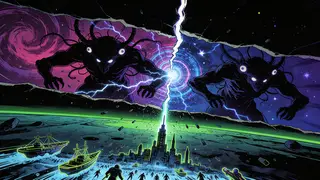
To most believers, angels descend from heavens, demons claw up from hells, fey slip from twilight realms, and devils arrive with contracts already inked. In truth, all are native to the Rift.
They did not cross over from outside reality. They grew here.
Each is a high-order Devotion structure: ancient braids of Intention, Awareness, and Devotion that refused to dissolve and instead accumulated more of themselves.
Angels form where duty, sacrifice, and protection have layered over ages.
Demons crystallize from mass slaughter, despair, and unrestrained hunger.
Devils coalesce around bargains, obligation, and hierarchy.
Fey bloom in cycles, stories, games, and loopholes—where rules exist to be twisted, not broken.
Deities are the largest, most stable structures of all: devotion basins so vast that they become landscapes and minds at once.
Their "bodies" in Real-space—wings, horns, masks, living sigils—are just the way mortals interpret contact with something too large to fit in a skull.
Mutual Corruption: Taint and Scar Tissue
The Rift’s Stain on Real-Space
Every Rift sailor knows about Rift-Taint.
Spend too long in the Maelstrom, and things come back wrong. Hulls warp with impossible angles. Crew come home with gaps where memories should be—or with new ones that never happened. Children are born with eyes that see things no one else does.
When Rift-space seeps into Real-space, Intention and Devotion leak into the physics itself. Probability bends. Cause and effect blur. Whole regions can become planar bleed zones, where reality gradually starts obeying someone else’s rules
Real-Space’s Wound in the Rift
What few realize is that the wound runs both ways.
Every time a ship plunges into the Rift, it drags along a bubble of Time and Space—concepts the Rift did not originally possess. Every Metronome pulse that Navigators use for orientation, every carefully plotted jump corridor, forces a little more linear sequence and geometry into places that were once timeless and formless.
For the natives—angels, demons, fey, and older things without names—these bubbles are painful. They impose order where there was only relationship and resonance.
Centuries of crossings, and the shattering impact of the Riftstorm Cataclysm, have carved scars through the Maelstrom: lanes, eddies, and dead zones where spacetime clings like scabs on a wound. Much of modern navigation depends on those scars—and many ancient beings would very much like to see them torn away.
Rift-Realms: Heavens, Hells, and Other Habitats
How Realms Formed
The early Rift had no map. Just flux.
Only after spacetime began bleeding in—through gates, drives, and catastrophes—did durable structures appear. Where Devotion pooled and spacetime snagged, Rift realms took shape: semi-stable basins in the storm.
Some look like cities of glass and song. Others are endless trenches of grinding stone. Some are forests that remember every footstep, or labyrinths where law is written into the walls. To pilgrims, they are as old as creation. To Navigators, they are recent scars with personality.
Sorting the Dead
When the dead arrive, they do not fan out evenly.
Devotion is weight. Realms are gravity wells. A soul steeped in martial discipline and ordered faith is likely to sink toward a different basin than one steeped in joyful rebellion or ruthless self-interest.
In most religions, this is the Judgment—reward, punishment, or binding service. From the Rift’s side, it is a practical process: braids are sent where they fit, broken down, and recycled into the ongoing ecology of Intention and Devotion.
The realms remember. And they grow.
Rift-Burgs: Islands of Matter in the Storm
What a Rift-Burg Is
Not all matter dragged into the Rift dissolves.
Sometimes a chunk of Real-space—an asteroid hive, a battle station, a whole district of a megacity—becomes snagged on a spacetime scar and refuses to let go. Over time, debris accretes, habitats are built, and a Rift-Burg forms: an island of familiar physics drifting in the Maelstrom.1
Sizes vary wildly. One Burg might be a kilometer-long wreck duct-taped to an ice shard; another might be an entire captured moon, its surface riddled with bunkers and domes.
Living on the Edge of Nowhere
Rift-Burgs are not safe. They creak, glitch, and shed debris under the constant pressure of the storm. But they are stable enough for life, and that makes them priceless.
On and around Burgs, you find:
Refueling depots wrapped in warding sigils.
Black markets trading in relics, souls, and navigation data.
Fortresses of factions that prefer their enemies to arrive exhausted.
Research citadels built by Archivists, Riftsworn, or worse.
Controlling a Burg means controlling the crossroads around it. Many a war has been fought over a rock that shouldn’t exist.
Cheating the Map: How FTL Really Works
Space Does Not Belong Here
In Real-space, two systems separated by ten light-years are always ten light-years apart. In the Rift, that statement doesn’t even parse.
Space is an imported concept, clinging only where ships, Metronomes, and fear have carved it in. The Rift’s own "distances" are measured in alignment of Intention and Devotion.
Two worlds locked in constant contact, trade, and shared ideology might be practically next-door in the Maelstrom, their Devotions forming a continuous current. Two neighboring stars that ignore each other—or hate each other in incompatible ways—can be separated by storms that would tear any ship apart.
Riding Currents Instead of Breaking Light
A jump, correctly understood, is a theological and psychological maneuver disguised as an engineering problem.
When a vessel enters the Rift:
Its Navigator reads currents of Intention and Devotion like a weather map.
The ship’s drives pour energy into a chosen current, aligning the vessel’s presence with a path through meaning-space.
The ship travels along a route that is conceptually short, even if the Real-space systems involved are many light-years apart.
When it emerges, no law of Real-space has been broken. The ship never moved faster than light in the metric defined by Matter-Space-Time. It just took a shortcut through a different kind of distance.
Why Devotion and Navigators Matter
This has consequences.
Navigators are not just math-savvy pilots; they are psychic sailors whose own Devotion profiles affect which currents they can safely ride. A crew deeply unified in purpose may find certain routes smoother. A faction that tears itself apart ideologically may find its lanes riddled with storms.
Some paths are safer for the Celestial Accord than for the Crimson Concord. Some routes open only to those who genuinely believe. Some are so old and overused that even a half-trained Navigator can manage them—able to feel the scar feel of Real-space’s imposed order under their metaphorical fingertips.
Time as Currency
The Rift makes all logistics uncertain. A jump can spit a ship out days, years, or centuries off-target if things go badly. Entire families and empires have come apart because someone’s ship arrived too late—or too early—for its own history.
In response, Starfall’s civilizations made time itself the coin that matters.
A Yom is not just a day—it is survival bottled and measured. A Dei survival pack buys you one Yom of life support. A Metronome pulse lets you sync your Yoms to everyone else’s. Every transaction—fuel, cargo, mercenary contract—is really a bet on how much time you have left to spend.
Chronologists, by tending Metronomes and fighting time drift, keep the entire economy from dissolving into chaos. They measure the heartbeat of reality while the Rift tries to throw it off.