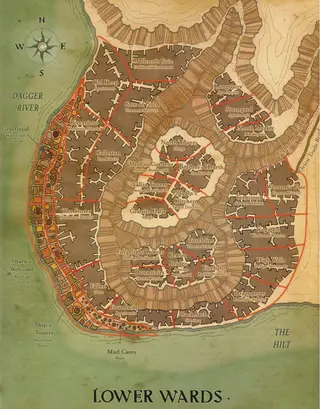
Lower Wards
"They call it the Lower Wards because 'Structural Mistake We Forgot People Lived In' didn't fit on the map." — Enta Spinwhistle, local author and cartographer
The Lower Wards are the parts of Sharn built beneath everything else — under towers, under bridges, under the wards that get sunlight and city services. Many blocks were once higher-status districts left behind as money and security moved upward. Others were never meant to be lived in at all: maintenance levels, structural voids, access corridors, and old annexes that became housing because people needed space and no one stopped them.
Lower Dura is the starkest example of this pattern. It was once the heart of Sharn — the original city, back when Sharn was Shaarat and the towers were young. The old ward included a garrison, noble manors, a temple district, and all the administrative infrastructure of a functioning settlement. Over centuries, as money followed sunlight upward, each of those institutions relocated to newer, higher, better-positioned buildings, leaving their former homes to whoever would take them. Today the traces of that history are visible in the bones of the architecture: worn cobblestone streets repaved over and over, great walls now covered in mildew and graffiti, a theater built to entertain nobility whose current customers are mostly there to conduct business the Watch doesn't want to know about. The district of Fallen — once called Godsgate, once Sharn's first temple district — took a literal blow in 918 YK when the Glass Tower was sabotaged and its spires crashed down into the neighborhood, shattering buildings and killing hundreds. The city council declined to rebuild it. Eighty years later, the ruins are inhabited by ravers and the restless dead.
This is what the Lower Wards share: they are where the city has stopped paying attention.
Light, Air, and Infrastructure
Conditions are consistent across most Lower Ward neighborhoods. Light is limited. Where the upper and middle wards use everbright lanterns, the lower wards make do with everburning torches — and in the worst neighborhoods, many of those have been shattered or stolen. Air circulation is poor. Smoke, damp, and industrial residue collect in pockets where the wind can't reach. The heat and soot of the Cogs bleed upward from the forges and foundries below, shaping schedules, health, and the texture of daily life in the districts nearest to the industrial undercity. Streets are narrow or irregular, built around load-bearing supports and patched walkways. Some areas feel stable; others are one bad repair away from collapse.
Housing is cramped and expensive for what it is. Subdivided tenements, repurposed ruins, and improvised additions are the standard. The population is dense and mixed: refugees, immigrant families, laborers, out-of-work veterans, and people priced out of higher wards. Cyran refugees have filled the district of High Walls in Lower Tavick's Landing beyond capacity. Many who arrived in Sharn after the Mourning found that the only lodging they could access was here, and most had little capacity to move. The city officially considers High Walls a refugee district; in practice it functions as a containment zone that the Watch can seal at any time, and the Guardians of the Gate keep close watch on the population within.
The Watch and Its Absence
The common understanding about the lower wards is that the Sharn Watch doesn't work here. This is not entirely accurate, but accurate enough to navigate by. The Watch concentrates its presence on economically important locations — Precarious in Lower Dura, for instance, is well-patrolled because the skydocks and warehouses there move goods critical to the whole city's economy, making it the only district in Lower Dura where the Watch maintains a real presence. The garrison district of Black Arch in Lower Tavick's Landing is fortified to withstand a siege. But outside these priority zones, the Watch's response to crime in the lower wards is typically very slow, and in some districts effectively absent.
Day-to-day authority falls instead to landlords, gang crews, community elders, union men, and anyone controlling access to work, water, heat, or safe passage. The logic of the lower wards is local: what holds a block together is the people on that block, and what happens to a stranger is rarely anyone's problem. Cooperation exists — shared tools, shared meals, informal childcare, neighbors watching each other's doors — because survival is easier with a network. But that cooperation is tightly bounded. It does not usually extend to outsiders, and it does not provide safety guarantees.
Criminal Terrain
The four major criminal organizations of Sharn — the Boromar Clan, Daask, House Tarkanan, and the Tyrants — all have significant operations in the Lower Wards, and the current state of this terrain is actively shifting.
Callestan in Lower Dura is the most concentrated nexus of criminal activity in the city: a district where all four organizations have a stake, and where the Watch does not interfere. Each organization operates in its lane — House Tarkanan handles assassination and theft; the Tyrants run forgery, deception, and prostitution; the Boromar Clan controls smuggling, gambling, petty crime, and illegal goods; Daask, more erratically, intrudes wherever violence is useful. The Silvermist, officially a dream parlor, operates openly as a dreamlily den. The Cracked Mirror changes its appearance and theme every week and is rumored to connect to the Tyrants. The Broken Anvil Inn provides rooms for those who prefer their hosts not to ask questions. Callestan is the best place in Sharn to find a fence, arrange a burglary, or acquire forged papers — and you don't have to worry about the Watch taking an interest.
Over the last two years this balance has been disrupted. Daask, whose elite Droaamite soldiers operate on guerilla tactics under the ultimate direction of Sora Katra, has been running escalating raids against Boromar operations throughout the lower wards. The Boromars, accustomed to their reputation for omnipotence, were caught flat-footed. They have hired Deneith mercenaries to protect some holdings — in Oldkeep, where they control most of the local businesses, these guards provide some deterrence against gnolls and ogres, but struggle against medusas and trolls. The Boromar Clan still controls most criminal activity in the middle and upper parts of the city, but Daask is winning the lower levels, and controls crime in the Cogs outright.
Malleon's Gate, Lower Dura's goblinoid slum, reflects this shift. The district has housed goblinoid families for over a thousand years — longer than most of the city's current towers have stood — and it has recently absorbed a significant wave of monstrous immigrants from Droaam and Darguun. Many of these are affiliated with Daask. The district contains a shrine to the Mockery established by the medusa Gasslak, and a temple to the Sovereign Host where the nine sovereigns are depicted as idealized goblinoids — a detail that most of Upper Sharn is unaware of, and that the handful who do know tend to find unsettling.
The Lower Wards by Quarter
The Lower Wards are not uniform in character. Each quarter's lower ward has its own relationship to the conditions above.
Lower Dura is generally considered the worst ward in Sharn proper — "little better than the Cogs," as the commonly heard phrase goes. Precarious is economically vital; everything else has been left to rot. Fallen is a ruin haunted by ravers and spirits. Callestan is a criminal nexus. Malleon's Gate is a monstrous immigrant community under Daask influence. Oldkeep, once the City Watch's garrison complex, was sold to landbarons and converted to housing after the Watch relocated upward. Its current residents mostly work in Precarious or the Stores and have ties, knowing or not, to the Boromar Clan.
Lower Northedge is a step up, though not far enough up that the difference is always visible. The people here are working-class laborers who have managed to avoid Lower Dura, and they intend to stay out of it. North Market is one of the oldest trading districts in the city — the cobblestones have been repaved more times than anyone has counted — and caters to everyday goods at modest prices, including a range of services oriented toward Sharn's shifter population, which is concentrated heavily in Lower Northedge. The Shrine of Fathen the Martyr in North Market commemorates a Silver Flame priest torn apart by wererats during the early days of the city; pilgrims still visit, and the local shifter population has no warmth for either the pilgrims or the church.
Lower Menthis is the entertainment district's least respectable level, and it is comfortable with that reputation. Torchfire's theaters — most notably the Ten Torches — specialize in bawdy musical comedy at cheap ticket prices, and fill their seats every night. Firelight is the city's most socially acceptable red-light district: changeling-run bordellos, gambling halls, and an itinerant blood sport competition called the Burning Ring that relocates constantly to avoid the Watch. The Ring is run by a shifter with Daask connections; monsters occasionally appear as combatants. This is considered a draw. Downstairs is where people go when the rest of Lower Menthis has worn them out, or when they need somewhere to end a long evening that began in the upper wards.
Lower Tavick's Landing is the city's ground-level entry point. Terminus Station, where the Orien lightning rail arrives and departs, anchors the district of Terminus. Wroann's Gate is where the Old Road enters the city, beneath a massive statue of Queen Wroaan. Most travelers who arrive by these routes do not linger in Lower Tavick's Landing — they take a lift or skycoach upward as quickly as possible, and the businesses here know it: inns, services, and caravan support catering to people who are passing through. The exception is those who have no choice but to stay. High Walls was converted from a residential district into a refugee camp during the Last War and has never been converted back. Dragoneyes, the ward's red-light district, is disreputable enough that even Firelight's customers consider it a step down.
Lower Central is the exception built into the lower-ward category: because Central Plateau is Sharn's wealthiest quarter, its lower ward functions more like a middle ward in economic terms. Boldrei's Hearth provides reliable, affordable lodging for travelers who can't afford Upper Central prices. Myshan Gardens is a residential district popular with young artists and people with unconventional lifestyles, who find the relatively low rents and downtown proximity worth the trade-off. Olladra's Kitchen offers modest-to-comfortable taverns and restaurants. Lower Central is not prosperous, but it is functional — maintained by proximity to the institutions above it in a way that Lower Dura, without those institutions, is not.
What Holds It Together
The Lower Wards are not only crime and deprivation. They are also where most of the city's actual labor happens: the dock work of Precarious, the manufacturing in the lower tower levels, the trade in North Market, the entertainment economy of Lower Menthis. They house an enormous portion of Sharn's actual population — densely, poorly, but persistently. The people who live here have built communities inside conditions the city was never designed to make livable, and they have maintained them without significant assistance from any institution with the power to help.
What the Lower Wards offer, for those who navigate them carefully, is access: to information, to people the upper city never sees, to goods and services that exist only where oversight is minimal. Callestan will find you a fence. Malleon's Gate will connect you to networks that cross into Droaam and Darguun. North Market will introduce you to communities that have been in this city longer than most of its towers. Lower Menthis will show you something that no licensed theater would stage. The city's vertical hierarchy creates the Lower Wards; the Lower Wards, in turn, know more about the city than the people above them ever will.
See also: Middle Wards · The Cogs · Boromar Clan · Daask · Sharn Watch · Lower Dura · High Walls · Callestan · Sharn (overview)