
Shortwave Ghost in the Machine
Networked Androids are the murmurs you hear when a ship goes quiet but the systems are still thinking.
They were originally built for machine‑to‑machine diplomacy—frames grown or assembled not in the image of organics, but in response to the needs of AIs, drone swarms, and starship minds that wanted a face they could talk to without translating everything into speech or text. Their perspective cores were slotted into shells laced with shortwave transceivers and mesh routing, turning their bodies into walking relay nodes. In Concordance foundries and rogue AI workshops, the prototype spec was straightforward: make something that can sit at a table with three organics, four drones, and a cranky shipmind and keep everyone in sync.
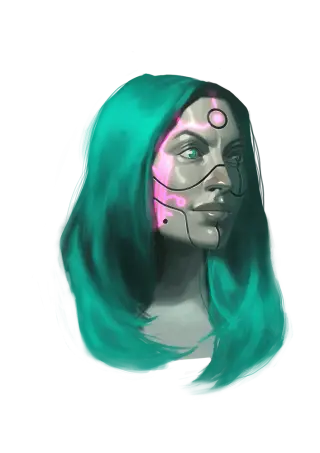
To outside observers, Networked Androids often look subtly off compared to baselines. Their eyes linger on security cameras, access panels, and drones the way others look at faces. They sometimes “speak” with a half‑second delay, because part of their attention is busy shuttling silent updates across a local mesh. In high‑traffic spaces—starports, Rift‑burg markets, service corridors—they leave a wake of handshakes and status pings, like a polite guest nodding to every appliance in the room.
Some were created directly by powerful artificial intelligences as bespoke envoys: shells whose primary job was to make the galaxy less hostile to machine kind. Others are self‑modded successors—Androids who let Concordance or Black Circuit technicians retrofit their bodies with mesh hardware until being offline around other tech felt like sensory deprivation.
Implications
Environmental Specialists: With a personal slot always available, Mod Fanatics are ideal hazard responders, swapping in vacuum seals, thermal capacitors, or environmental seals before each job without sacrificing their main armor’s own customization scheme.
Field Techs & Test Pilots: Guilds and megacorps use them as walking testbeds—installing prototype armor upgrades directly into an Android who can give precise sensory feedback, then uninstall the hardware between focus groups.
Fashion and Identity: In star‑hubs where body modding is art, these Androids treat upgrades like seasonal wardrobes: glowing subdermal fields for club nights, stealth baffles for quiet gigs, ceremonial projectors for guild rituals—each loadout saying something about who they are this cycle.
Societal Impact
Mod Fanatics have become mascots—and sometimes scapegoats—for Starfall’s culture of perpetual upgrading.
On the bright side, their existence pressures manufacturers to standardize armor‑upgrade interfaces, because anything that fits a baseline cuirass must now also negotiate with a growing population of Androids who are the armor. This has led to open‑standard schematics, black‑market clone shops, and a small but fierce “right‑to‑repair‑your‑chassis” movement in Concordance space. Many Starfall mod shops advertise “Android‑safe upgrades tested on willing Mod Fanatics,” and some synth communities organize swap meets where everyone brings a spare module to trade.
On the darker side, corpo legal teams argue that heavily modified frames blur the line between person and product, especially when a body’s resale value starts appearing on insurance forms. Security guilds obsess over Mod Fanatics as wildcards: today that dockworker’s slot hosts a basic shield projector; tomorrow it might be an active camouflage rig or a forbidden battlefield mod smuggled in under their synth‑skin. In some conservative enclaves, heavily modded Androids are treated with the same suspicion reserved for walking scrapheaps or drift‑touched exocortexes—useful, impressive, and always one catastrophic firmware update away from disaster.
Mod Fanatic Androids embody Starfall’s creed that survival and identity are both builds you keep updating—not just gearing up for the galaxy, but literally rewriting what their own bodies are capable of one upgrade at a time.
Number of Hit Points Gained on 1st Level
Number of feet moved per stride action
Ability Boosts applied during character creation
Ability Boosts applied during character creation
Languages known by the typical member of this Ancestry You can learn additional languages equal to 1 + your Intelligence modifier (if it's positive). Choose from the list of common languages and any other languages to which you have access.