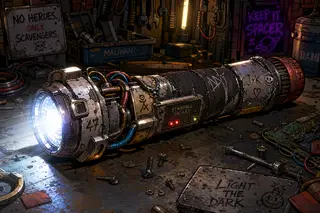
A Starfall flashlight is a cheap, level‑0 tech item that sheds bright, reliable light while tying up only one hand, making it standard kit for almost everyone from station cops to Rift salvagers.
A flashlight is as basic as air filters and water reclamation—no spacer, cop, or tunnel‑rat leaves home without one. The commercial flashlight is a rugged, handheld tube of alloy and polymer with a high‑output LED cluster or micro‑laser emitter at the business end, throwing a harsh white beam that cuts through the haze of coolant leaks, Rift fog, and station smog. You see them everywhere: clipped to guild security belts, magnet‑mounted inside access shafts, dangling from the harnesses of asteroid miners who’ve outlived three suits but still trust the same dented light.
Unlike the anemic backup flash on a personal comm unit, a proper flashlight is built to survive abuse—dropped down ladderwells, submerged in bilge, baked by reactor waste heat, and still good to go after a shake and a curse. Cheap models run hot, flicker at low charge, and stain everything in a bluish glare; higher‑end units swap in adjustable beams, neutral color temperature for forensic work, and armor‑plated lenses that can shrug off shrapnel. In the lowest decks and fringe colonies, a working flashlight can be worth more than a week’s food—light means you can work a shift, fix a leak, or see what’s waiting in the dark before it sees you.
Culturally, flashlights have become part of the visual grammar of Starfall authority. A beam snapping on in a back‑alley deal usually means station cops or guild enforcers have arrived; smugglers and syndicates counter with red‑tinted lights that don’t blow their vision when the shooting starts. Nomad fleets paint their flashlights in clan colors, adding carved grip patterns and charms dangling from the lanyard: tiny holo‑charms of home stations, prayer beads, or spent casings from the first time that light saved their life.
Implications
Inspection & Maintenance: Engineers use flashlights to check microfractures in hull plating, trace leaky conduits, and read serial numbers in cramped service corridors where fixed lighting is unreliable or sabotaged.
Exploration & Surveying: Explorers, archaeologists, and scavengers sweep derelict stations, Rift‑scarred wrecks, and unlit caverns, using beam control to signal teammates and pick out surface irregularities or tripwires.
Emergency Signaling: In blackouts or comms‑jammed zones, flashlight beams become improvised signal flags—blink codes through bulkhead windows, rhythmic sweeps in vacuum, or patterned pulses seen on distant catwalks.
Societal Impact
Cheap, level‑0 flashlights helped collapse the divide between “lit” guild districts and the perpetually dark underdecks by giving every worker, squatter, and scavver their own portable bubble of safety. In poorer colonies where infrastructure lags behind guild propaganda, people joke that the sun sets not when the sky goes dark, but when the last flashlight battery dies. Black‑market vendors hoard high‑capacity cells and ruggedized models, renting them out for hazard shifts or salvage runs when locals can’t afford to buy outright.
At the same time, the ubiquity of portable light has changed how power operates. Guild patrols use synchronized flashlights to blind crowds and control movement, sweeping beams like cattle prods of illumination that tell people where they’re allowed to stand. Resistance cells respond with anti‑light tactics—smoke bombs, reflective tarps, and hacked drones that throw decoy beams to draw fire or fake the approach of a larger force. In data‑cult enclaves and Rift‑worshipping sects, visible light is sometimes treated as a pollutant; members use narrow‑band or IR flashlights instead, turning visible darkness into a kind of ideological statement.
In Starfall, a flashlight isn’t just a utility item—it’s the line between terror and visibility, between losing yourself in the dark and choosing where to shine your attention in a galaxy that would rather keep some things unseen.