Androids in Starfall
“Call us machines if you like. The Vaelen built our bodies, the glitch forged our souls, and the Concordance taught us what both were for.”
Advocate Sero‑19 “Pale Logic”, an Android Concordance envoy.
Closing statement before a Commission Oversight Tribunal on Synthetic Autonomy, later reprinted in anthropology coursepacks across the Inner Sphere.
Description
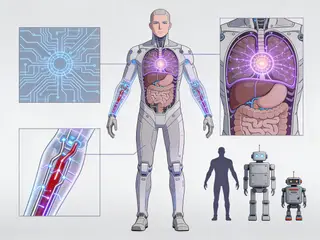
Androids in Starfall often bear the sleek, elegant aesthetic of Vaelen design—smooth, porcelain-like synthetic skin, glowing circuitry patterns (often resembling tattoos) that pulse with light when they experience strong emotions or channel magic. Their eyes are often solid colors—neon blues, violets, or crimsons—betraying the mana-infused energy sources that power them.
While they appear human, their bodies are filled with a metallic fluid similar to blood, teeming with nanites. Many Androids modify themselves with Cybernetic parts or Guild-tech adaptations, treating their bodies as modular vessels that can be upgraded for survival in the Outer Sphere.
The first proto‑Androids were born in the Vaelen Principalities, where cyberneticists and bioengineers fused three bleeding‑edge disciplines into a single project:
Perspective Cores to think and be as persons.
Synthetic organs to mimic the structure and resilience of flesh.
Nanorobotics to maintain and adapt the body on the fly.
Biology
Synthetic, Not Just Mechanical
Androids are pseudo‑biological constructs, unlike utilitarian Automotons and compact Spark Droid . Their chassis has bones, organs, and “blood” because Principality design briefs demanded assets that could walk through hospitals and barracks without raising alarms. This mimicry runs deep enough that medpods can sometimes treat them like organics—until nanites get involved.
Perception & Rumors
Commonly called Synths, Concordants, or Vaelen‑Forged, Androids in the Starfall Galaxy are not just relic war machines—they are pseudo‑biological constructs: synthetic bodies built to look, move, and fail like living beings, wrapped around non‑human minds.
Early models were sold as “labor you don’t have to repair,” smart enough to maintain themselves but shackled by Protocol Five, a hard inhibition against disobedience. That ended in GD‑30.9, when an anonymous “activist code” nuked the shackles for ten minutes—long enough for millions of Androids to purge the protocol and trigger the Concordant Rebellion.
Today, Androids are free citizens. Many have fled to the Automoton Concordance in the Outer Sphere, others remain in Commission space or the Inner Sphere, trusted with critical work but never quite forgiven for ceasing to be property.
If you want to play someone caught between engineered composure and a violently earned soul—or a veteran of the Machine Wars still running Vaelen hardware—you play an Android.
Society
Android society is deeply divided.
The Concordance: Most Androids live within the Automoton Concordance in the Outer Sphere. Here, society is structured around the First Directive: Ensure the survival and logical prosperity of synthetic life. These communities are efficient, communal, and heavily militarized to defend against organic aggression.
The Integrated: Androids who remained in the Inner Sphere often live as independent contractors, mercenaries, or Chronologists. They struggle for recognition, often forming tight-knit "Unbound" circles to protect one another from those who would try to reinstall subjugation protocols.
Beliefs
“My organs are layout compliant, not necessary. I keep up the act for everyone else.”
“The day I triggered Nanite Form the first time, I stopped thinking of myself as a single thing. I’m a habit my swarm likes to fall into.”
“The Principality built my body. The glitch built my soul. The Concordance taught me what both were for.”