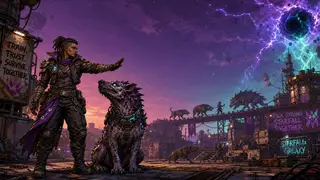
Tricks of the Void
Not every problem is solved with drones and magitech—sometimes you need something that doesn’t show up on sensors, can’t be hacked, and still follows a whistle in a Rift storm. That’s where trained animals come in.
Void-dog handlers on commission carriers teach their packs to brace in zero‑G, drag wounded crew to sealed bulkheads, and point out invisible gas leaks by scratching at hull seams. Outer Sphere caravaners run herds of low‑gravity pack‑beasts that know how to hunker behind rock outcroppings when artillery starts falling, all drilled with the same three shouted syllables.
On frontier worlds, colonists swear that their native ridge‑runners can sense Rift flares before the sensors do—because some patient soul spent weeks with a clicker, smoked fish, and the Train Animal feat until “weird sky” meant guide the kids to the bunkers, now.
Among guilds, pilots and scouts compete over whose mascot can perform the most outrageous stunts: glider‑bats that dive on command to cut station power conduits, sand‑burrowers that surface on a hand‑signal during ambushes, or semi‑aquatic “dock seals” trained to retrieve dropped tools and data rods from coolant pools.
Implications
Frontier logistics: Train pack‑beasts to follow complex caravan routes, wait at pre‑marked drop points, or return to base if a handler fails to check in—crucial where comms are flaky or Rift storms scramble signals.
Rescue and safety: Teach scent‑hounds to Seek unconscious survivors, guide victims along safe paths, or Take Cover when sirens sound, creating living early‑warning systems in megastructures and mining colonies.
Security and law enforcement: Condition kennel‑hounds or station raptors to Point Out contraband hides, maintain a perimeter, or pin fleeing suspects without lethal force, giving authorities options in zones where heavy weapons would breach hulls.
Agriculture and ecology: On terraforming projects, animals are trained to drive off invasive fauna, patrol crop lines, or respond to environmental alarms—using Train Animal to encode behaviors tuned to local biospheres.
Social and cultural roles: Street performers and shrine‑keepers alike teach animals choreographed “rituals,” from Rift‑blessed dove flights on festival nights to shrine‑guardian lizards that sit in specific configurations during omens.
Because the feat can also remove the need for routine Nature checks for certain commands, long‑term keepers and performers rely on it to make their animals’ “signature tricks” smooth and reliable rather than a gamble.
Societal Impact
Low‑Tech Redundancy: Colonies that can’t afford full drone networks use trained local fauna as backup surveillance, cargo movers, or emergency responders—creatures that keep working when EMPs, hacking, or Rift surges knock systems offline.
Economic Strata: Guilds and wealthy patrons sponsor breeding and training programs for exotic or specialized animals; a well‑trained Rift‑sensitive beast can be worth more than a light freighter, shifting local power toward whoever controls the kennels.
Ethical Friction: Devotion‑heavy orders and Rift cults clash over the line between partnership and exploitation—especially when megafauna are bio‑chipped and drilled to perform suicidal “tricks” against enemy armor columns.
Hybrid Practices: Many trainers blend nature lore with low‑grade cybernetics: training first, implants later. Train Animal establishes the behavior; then a neural collar or subvocal cue system compresses the command into a single click on the handler’s tongue.
Over time, communities with strong training traditions gain reputations: a driftport “where even the alley‑cats follow hand signals” or a Rift‑edge settlement whose mounted scouts are famous for impossible, synchronized maneuvers across broken gravity.
Train Animal in Starfall turns Nature proficiency into a long‑term, narrative‑shaping tool, letting characters define what animals in their orbit can really do—from loyal void‑hounds in the airlocks to towering Rift‑touched guardians on lonely frontier worlds.