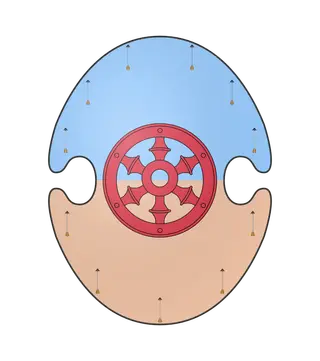
Warriors of the Great War
The origins of the Clandom of Māt Ṣēri lie in the final years of the Great War of Naplica, when the Gods themselves still walked among the armies of mortals. Among the many peoples who fought in that catastrophic conflict, none were more feared than the ancestors of the Ṣērû.
Forged in the harsh grasslands that bordered the eastern plains, the early Ṣērû were unmatched riders and charioteers. Their swift horses and mobile war-carts allowed them to strike across vast distances, appearing suddenly on battlefields before vanishing. While many armies fought as heavy infantry beneath divine banners, the Ṣērû became the gods’ instrument of movement and shock, harrying enemy supply lines and shattering flanks with thunderous chariot charges.
Legends claim that entire hosts were broken beneath the iron-rimmed wheels of their war-carts. Whether these tales are exaggerations or not, even the divine chroniclers of the war agree that the Ṣērû chariot hosts were among the most decisive forces in the conflict’s final campaigns.
When the Great War ended, and the enemies of the gods were defeated, the armies of Naplica were dissolved. The human hosts that had been created for battle suddenly found themselves without purpose in a world they had never known.
Among these peoples, the Ṣērû were perhaps the most feared. Hardened by war and unmatched upon the open plains, many feared they would become conquerors. Instead, the gods granted them a different fate. The vast steppe plains of eastern Naplica—lands once dominated by the distant influence of Lóngyuán—were declared the inheritance of the chariot warriors.
In recognition of their service in the Great War, the gods bestowed upon them dominion over the grasslands, proclaiming that no other people would rule the plains so long as the chariots of the Ṣērû still rode.
The warriors became settlers. But unlike other humans who built cities and kingdoms, the Ṣērû chose a life that preserved the freedom of the steppe. They became nomads, following the great herds and the rhythms of the wind across the endless grasslands.
Thus began the rule of Māt Ṣēri — the Land of the Ṣērû.
The Taking of the Great Plains
The plains that the gods granted were vast but not empty. The remnants of the Lóngyuán civilization lingered in scattered ruins and broken fortresses across the grasslands, their once-great cities reduced to silent stone husks.
The early Ṣērû did not rebuild these cities. Instead, they embraced the freedom of the open steppe, believing that the gods had granted them not walls but horizons. The clans spread across the plains with their horses and chariots, establishing seasonal encampments along rivers and fertile pastures.
Over generations this way of life hardened into tradition. The people of the plains became masters of mobility, able to traverse distances that would cripple most armies. Herds of steppe-horses multiplied across the grasslands, and the crafting of chariots became both a sacred art and a symbol of noble status.
It was during this period that the three great branches of the Ṣērû emerged: the Nārî, Tamḫāri, and Tiamti, each adapting the ancient traditions of the plains to their own geography and ambitions.
Rise of the Great Khans
Though the clans of the plains were fiercely independent, periods of crisis often produced leaders capable of uniting the tribes beneath a single banner. These rulers, known as Great Khans, were typically drawn from the powerful Ṣērû Nārî, who controlled the vital waters of the Šutur-na River.
From their fertile riverlands the Nārî commanded the logistical heart of the steppe. Grain shipments, horse herds, and the movement of heavy goods all depended upon the Šutur-na, giving the Nārî immense influence over the other tribes.
When united beneath a Great Khan, the armies of Māt Ṣēri were among the most formidable forces in the world. Bronze-armoured chariots drawn by four-horse teams thundered across the plains, supported by swift outriders and mounted archers. Entire kingdoms learned to fear the open fields, where the chariot-lords held absolute advantage.
Even today, military theorists across Naplica warn that to fight the Ṣērû on the plains is to fight them on their own terms—and that is rarely survived.
The Three Peoples of the Steppe
Over time the unified culture of the early Ṣērû diversified into three distinct traditions.
The Ṣērû Nārî, dwelling along the Šutur-na, became the dominant political force of the plains. Their heavy chariots patrol the fertile riverbanks, and their aristocratic clans have produced most of the Great Khans who have ruled the steppe.
To the west, the Ṣērû Tamḫāri developed into master traders. Their proximity to foreign markets transformed them into the diplomatic and economic intermediaries of the plains. Acting as middlemen between the steppe and the city-states beyond, they established tributary relationships with the river civilizations of the Tepir-ša, and today they command immense wealth through trade.
Along the southern coast dwell the Ṣērû Tiamti, a people often regarded with suspicion by their inland kin. Living where the grasslands meet the sea, they adopted maritime customs and coastal trade, even developing small vessels to supplement their traditional chariots. Though sometimes dismissed as outsiders by the other Ṣērû, their coastal settlements have become valuable gateways for foreign commerce.
Despite these cultural differences, all three peoples remain bound by the ancient traditions of the steppe and the prestige of the chariot.
The Power of Māt Ṣēri
Today the Clandom of Māt Ṣēri stands as the undisputed military power of the Great Plains and one of the most formidable forces in all Naplica.
Though their wealth is modest compared to the merchant republics of the rivers and seas, their armies remain unmatched in mobility and discipline across open terrain. Vast hosts of chariots can be assembled with terrifying speed, and their horse-breeding traditions have produced the fastest steppe steeds known on the continent.
For this reason, few nations dare challenge them directly. Most neighbouring states instead seek treaties, tribute arrangements, or trading relationships with the clans of the plains.
Yet for all their power, the Ṣērû remain a people defined by motion rather than conquest. Their cities are few, their camps ever shifting, and their authority rests not upon walls but upon the endless grasslands granted to them by the gods at the end of the Great War of Naplica.
And as long as the steppe-horses run beneath the wide skies of the plains, the chariot-lords of Māt Ṣēri will remain masters of the horizon.