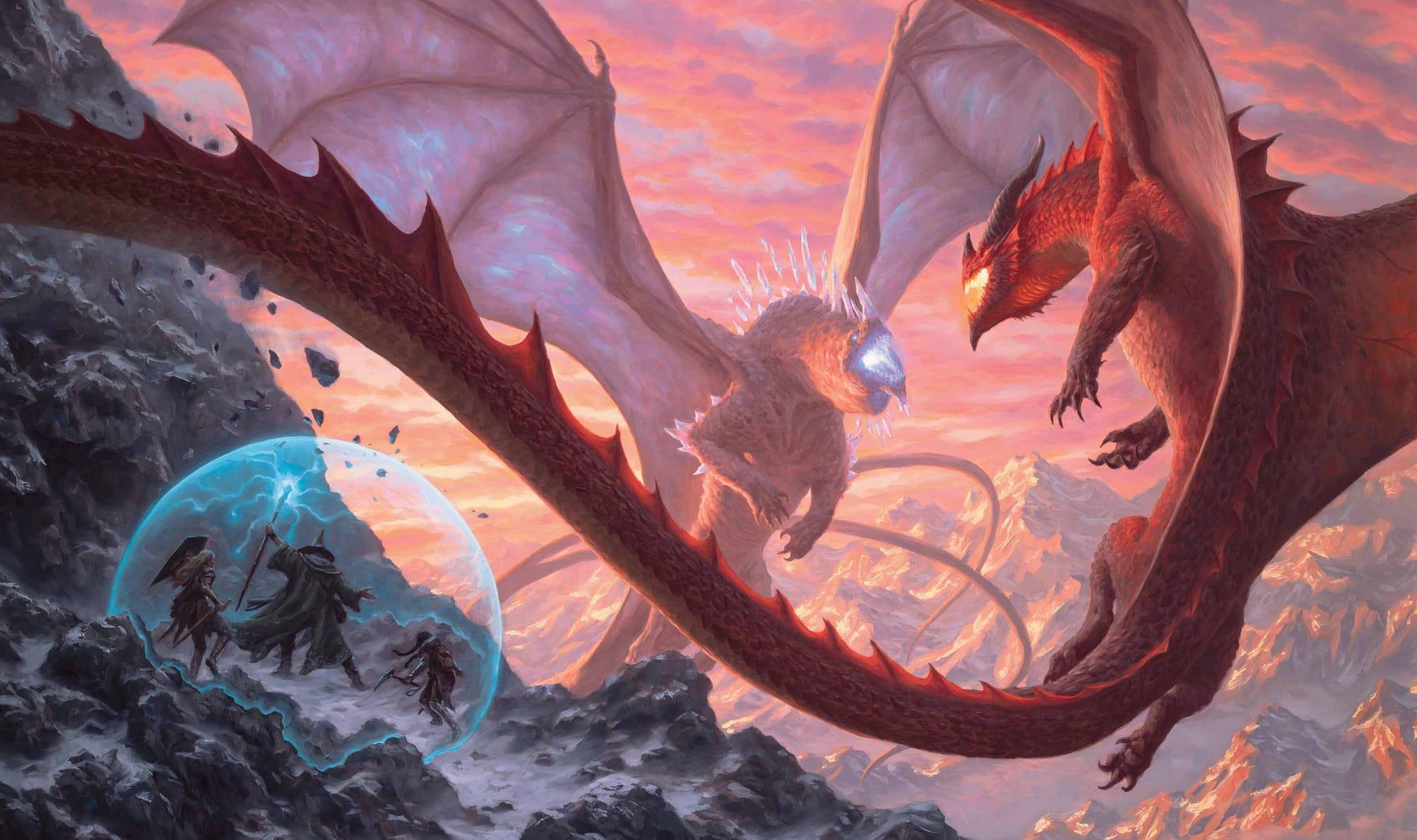
There are many different kinds of dragon in the world of Dungeons & Dragons - but what do the different dragon colors in DnD mean?
How does a Red Dragon differ from a Brass Dragon? Do the colors actually matter, or are they just aesthetic differences? And are there actually any good dragons?
Learn all about the different types of dragon from the monster manual: their personalities, powers, and allegiances.
Chromatic, Metallic, and Gem Dragons
For the most part, all dragons in the Dungeons and Dragons Forgotten Realms can be categorized into one of three main groups: Chromatic, Metallic, and Gem Dragons.
In earlier versions of the tabletop roleplaying game, all dragons were classified as having an evil alignment - they were monsters that were designed to be fought. However, when Metallic Dragons were added to the fantasy RPG later down the line, these gigantic lizards were allowed to have some more moral complexity. The arrival of 4th edition saw the previously assigned moral alignments lose their importance, with Dungeons & Dragons now putting the responsibility of chosen morality in the Dungeon Master and players’ hands.
And remember, though there might be core differences between these three categories, all D&D dragons - including offshoots like drakes, wyrmlings, and deep dragons - love treasure of some kind.
Chromatic Dragons
Black Dragons

Besides their scale color, Black Dragons are primarily defined by the skull-like appearance of their heads. They’re a typically more aggressive, evil dragon type, with a long history of cruelty and many allies amongst cultists, the undead, and doomsayer types.
Black Dragons favor living in fetid swamps and haunted ruins - places of magical corruption. They have the ability to breathe burning acid and invoke fear in their enemies, as well as summon clouds of insects.
Challenge Rating: 14
Biggest threat?: Definitely the acid breath weapon.
Blue Dragons

These huge beasts command respect and service from their followers, using their authority against perceived rivals to maintain dominance.
Blue Dragons tend to live within deserts, and other places where they can keep a wide vigilance on their surroundings (being eternally paranoid of possible enemies). They’re masters of lightning breath powers, and have the ability to turn invisible during flight.
Challenge Rating: 16
Biggest threat?: They have armies and lightning breath.
Green Dragons

Green Dragons’ preferred homes are ancient forests. Though equally massive, this type of dragon prefers to use their mind as a weapon, rather than their body. Secretive, scheming, and solitary, Green Dragons hide away in forests and pull strings to manipulate others.
Green Dragons possess poisonous breath powers and the ability to hurt others’ minds, but will always choose to use their intelligence over physical attacks.
Challenge Rating: 15
Biggest threat?: These guys are master schemers.
Red Dragons

Red Dragons command their armies through raw power, rather than intelligence and respect. Though Red Dragons might have control over large territories, they’re rarely interested in actually ruling - preferring to indulge in their own pleasures instead.
Red Dragons choose to live in volcanic, blisteringly hot places, which match their fire breath powers and immunity to fire damage. They’re extremely arrogant, even for the average dragon, and believe that they are the greatest of all lizardkind.
Challenge Rating: 17
Biggest threat: Their terrible, Tiamat-esque tempers.
White Dragons

These tremendous beasts are extremely defensive of their territories, and will square up against any monsters or creatures occupying the surrounding area.
White Dragons live in frigid, icy, and isolated climates far away from civilization. Unlike their Chromatic brethren, White Dragons are predominantly concerned with brute survival and will use their size - alongside their frost breath - to protect themselves.
Challenge Rating: 13
Biggest threat: A lifetime of monster slaying experience.
Metallic Dragons
Brass Dragons

Brass Dragons are incredibly sociable creatures, keen to engage in conversation with humanoid societies, rather than interact with their own kind. Instead of terrifying locals, Brass Dragons will often transform themselves into less threatening merchants or storytellers to chat.
You’ll find Brass Dragons mostly in arid and warm climates, such as deserts or canyons. When threatened, Brass Dragons will protect themselves with their fire and sleeping magic: incapacitating and burning enemies.
Challenge Rating: 13
Biggest threat: Putting you to sleep with sleeping magic or endless conversation.
Bronze Dragons

Bronze Dragons favor themselves as patrons of humanoid cities, choosing to use their immense size and powers to protect their people. These yellow dragons are drawn to places of great potential, watching as new discoveries and innovations are made.
Unusually, Bronze Dragons prefer to live underwater - shaping lairs from places of oceanic beauty, and filling them with them with lost treasures. This dragon type will defend themselves with their lighting and force abilities.
Challenge Rating: 15
Biggest threat: Getting eaten Jaws-style.
Copper Dragons

Copper Dragons are mischievous and known pranksters, having a deep appreciation for good wit and an excellent joke. They also enjoy other forms of entertainment like storytelling, music, and riddle-telling.
Rather than manmade things, this brown dragon-type collects precious metals and stones. To prevent others taking their treasures, Copper Dragons will leave decoy items around their lairs hidden amongst hills and caves. If their hoard is threatened, Copper Dragons will protect it with acid and slowing breath attacks.
Challenge Rating: 14
Biggest threat: Slowly melting in acid.
Gold Dragons

Gold Dragons use their power and influence to subtly shape the world around them, treating everything they touch with care. From whatever magnificent ruin or serene forest they call their home, Golden Dragons will use treasures they’ve gathered over the years as bargaining chips to enact change, and serve the platinum dragon, Bahamut.
Though they prefer to use their minds and diplomatic abilities, if pushed, Gold Dragons can fight enemies using their banishment powers and weakening breath.
Challenge Rating: 17
Biggest threat: Get banished to the Seven Hells.
Silver Dragons

Silver Dragons admire ambition, standing against any evil threatening to disturb the peace that would enable greatness. Though preferring to live in mountainous retreats, Silver Dragons will choose to live amongst humanoid civilizations to witness the creation of brilliant art, incredible feats, and historical events.
If peace is disturbed, Silver Dragons will protect themselves and their allies with their large size, as well as breath attacks capable of paralyzing and freezing.
Challenge Rating: 16
Biggest threat: Witness your house being accidentally crushed.
Gem Dragons
Amethyst Dragons

Amethyst Dragons use their psionic powers to monitor the multiverse, keeping a keen eye on anything that might upset the balance. These purple dragons are sworn enemies of creatures originating from the Far Realms, the home of Mind Flayers and other abominations.
As they observe the various planes of existence, Amethyst Dragons may choose to impart their knowledge to those they deem wise enough. Amethyst Dragons’ psionic powers are so intense, that they can fly using their mind instead of their wings. These dragons can also use singularity powers and crystal attacks to defend themselves.
Challenge Rating: 16
Biggest threat: Be mistaken for a Mind Flayer.
Crystal Dragons

Crystal Dragons have a connection to the Positive Plane, which powers their life and light-gifting abilities, as well as their bright and warm personalities. These sparkling creatures are fascinated with the sky and stars, studying the cosmos over years from their frozen lairs.
Besides their love of cosmology and astrology, Crystal Dragons exude an optimistic attitude, and often perform nurturing actions to smaller creatures. When provoked, these gemstone-colored Dragons use their radiance powers to great effect.
Challenge Rating: 12
Biggest threat: You produce too much light pollution.
Emerald Dragons

Emerald Dragons are the most cunning of all dragonkind, with a gift for manipulation and abilities designed for illusion. Using their psionic powers, Emerald Dragons can deceive others by painting illusory images - whether to disguise themselves to walk amongst humanoids, or to protect themselves from enemies.
Emerald Dragons are keen to feed their curiosity about the world, with their greatest treasures being rare information and knowledge. If threatened, Emerald Dragons will distract and sabotage their opponents with psionic powers.
Challenge Rating: 14
Biggest threat: Fall through an imaginary floor.
Moonstone Dragons

Moonstone Dragons are descendants of a clutch of eggs that were supposedly hidden within the Feywilds. These elegant dragons have the inherent ability to communicate through dreams, projecting themselves into others’ minds for mischief and knowledge gathering.
Moonstone Dragons have a fascination for stories and art, reaching out to humanoid civilizations to hear songs, witness paintings, and read books. Dreams can also be used by Moonstone Dragons for self-defense purposes, if needed.
Challenge Rating: 15
Biggest threat: A Moonstone Dragon witnesses a really embarrassing dream.
Sapphire Dragons

Sapphire Dragons are master tacticians, spending their days conjuring up strategies against possible and actual enemies. As with Amethyst Dragons, Sapphire Dragons have a deep seated hatred of aberrations, and invaders from the Far Realms.
Sapphire Dragons like to collect weaponry and armour from fallen enemies, who they often vanquish through a combination of stunning psionic powers, alongside telekinetic abilities.
Challenge Rating: 15
Biggest threat: A Sapphire Dragon thinks about you.
Topaz Dragons

Topaz Dragons are the antithesis of Crystal Dragons, drawing upon the Negative Plane for their powers and disposition. As such, Topaz Dragons represent entropy, ruminating on the inevitability of the decomposition of everything.
Despite their morbid nature, Topaz Dragons are not necessarily anti-social creatures. In fact, these creatures will clear the way for the birth of new life and growth. Topaz Dragons can tap into entropic powers when threatened by their enemies.
Challenge Rating: 13
Biggest threat: Literally crumbling into dusk from dragon’s breath.