Faith in a Silent World: Divine Belief Across Khorvaire and Beyond
"The gods are present in all things. The fire that warms your home, the sword that defends your family, the harvest that feeds your children — all are touched by the divine. You ask me for proof? Look around you." — Common Vassal response to the question of divine silence
The Divine Silence
A Seeker of the Blood of Vol bleeds into a chalice, certain that divinity lies within her own veins. A templar of the Silver Flame lays hands on a wounded child, calling down healing light from a force she knows bound the overlords at the dawn of time. A Vassal blacksmith pauses at his anvil and thanks Onatar for the day's work, confident the Sovereign of the Forge stands beside him at the bellows. All three of them channel real, demonstrable, supernatural power — the kind that heals wounds, turns undead, and smites fiends. And none of them can prove the other two wrong.
This is the fundamental condition of faith in Eberron. Divine power is evident everywhere — manifest in miracle, blessing, and the channelling of forces that no arcane formula fully explains. Yet no deity has ever appeared in universally acknowledged form. No god walks the world. No irrefutable voice has answered a prayer in terms the sceptic could not dispute. An acolyte might spend years meditating and praying, performing virtuous deeds and tending their flock, and never gain the power to cast a single spell; meanwhile, an illiterate farmer might feel Onatar's guiding hands and cast magecraft without any training at all. Why one and not the other? People of faith usually respond that it is because the farmer was chosen, or because one soul was more open than the other to divine guidance. Maybe that's true. Or maybe it's all just luck.
What is certain is that divine magic requires two things: absolute faith and a connection to a source of divine power. The faith must be genuine — not rational, not reasoned, but felt with the kind of certainty that admits no doubt in the moment of casting. And the source must be real, even if its true nature remains stubbornly unclear. Whether that power flows from a god, from collective belief, from the caster's own soul, or from some deeper property of the world is, to the outside observer, genuinely uncertain. The theologian Phthaso Mogan of Sharn once documented a man who performed miracles based on fanatical devotion to his own shoe; Mogan concluded the man was actually receiving power from Kol Korran, the Sovereign of Travel. The Korranberg scholar Dravo Den Talas proposed an alternative: that if there is any truth to the Blood of Vol's claim that divinity lies within the self, all divine magic might simply be drawn from the caster's own mystic spark, and the object of belief might be entirely irrelevant.
This absence of certainty does not diminish faith. If anything, it broadens it. Without a definitive divine authority to settle doctrinal disputes, every tradition is free to develop along the lines that best serve its people. Theologies multiply. Sects diverge. A Karrnathi Vassal and a Thrane Purified may both pray with genuine conviction, draw on real power, and each be absolutely certain the other is missing the point.
What faith does rest on, in every tradition recorded below, is function. It orders communities, sustains armies, preserves the dead, gives individuals reason to act with more than self-interest, and — in the most practical terms — keeps the fiendish overlords bound in their prisons. The silence at the centre of Eberron's theology has not produced nihilism. It has produced an extraordinary diversity of answers.
From a treatise by Dravo Den Talas, University of Korranberg:
"Consider the paradox. A paladin devoted to the Lord of Blades draws on divine power to smite her enemies — and the Lord of Blades is a living warforged with no obvious means of granting such power. A cleric of the Sovereign Host heals the sick by invoking Boldrei — a deity whose existence cannot be empirically demonstrated. A Seeker priest communes with something that tells him things he cannot possibly know, and attributes this to his own nascent divinity. Either one of these sources is real and the others are delusions, or all three are drawing from something none of them fully understand. The first answer requires a great deal of special pleading. The second is more elegant, and considerably more frightening."
Major Religious Traditions
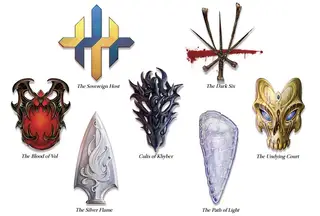
The Sovereign Host
The most widely practised religion in western Khorvaire, the Sovereign Host is a pantheon of nine deities — the Sovereigns — each governing an aspect of civilised life. Arawai holds dominion over harvest and abundance. Aureon is lord of law and knowledge. Boldrei is the foundation of community and hearth. Kol Korran watches over commerce. Olladra governs luck and feast. Onatar guides the hands of every crafter and artificer at their forge. Balinor walks the boundary between civilisation and the wild. Dol Arrah embodies honour and wisdom in war. Dol Dorn is the patron of the common soldier.
The faith is deeply decentralised. There is no unified church authority, no pope, no doctrinal inquisition — only a network of largely independent temples and liturgical councils that maintain loose coordination across the Five Nations. This absence of hierarchy is not a weakness but a survival mechanism. Without a central authority to destroy, the faith cannot be decapitated; without a rigid creed to enforce, local practice is free to adapt and absorb whatever it encounters. Repeatedly throughout history, Vassals have arrived in a region, observed local spiritual customs — ancestor rites, spirit worship, unnamed gods of hearth and harvest — and folded those practices into the Host until, within a generation or two, the locals were Vassals themselves without quite remembering when the change occurred. The faith does not compete with local tradition. It absorbs it.
Followers are called Vassals, and their practice is woven into every aspect of daily life: brief prayers at meals, candles in the appropriate colour before a hunt or a wedding, minor rites performed without a priest. Most Vassals spend less than half an hour a day in total observance, spread across many small moments — a word to Kol Korran before a negotiation, a hymn to Boldrei upon returning home — rather than concentrated in a single act of worship. The degree of devotion varies enormously, but even people who would not call themselves religious know the names of the nine Sovereigns, sing their songs, and close their shops on Boldrei's Feast. By and large, if you live in the Five Nations, you are assumed to be a Vassal unless you specifically say otherwise.
A faction called the Sovereigners takes the faith's universalist claims to their logical extreme: they believe that every other religion in existence is simply a different, incomplete understanding of the Sovereign Host. The Silver Flame? A particularly stringent expression of Dol Arrah. Druidic practice? Nature worship that has not yet recognised what it is actually worshipping. Other faiths find this attitude offensive in the extreme. It takes real hubris to tell someone, "Your god is actually just a misconception of my god." Hubris in a priesthood — shocking, isn't it?
Regional doctrine varies significantly. In Karrnath, the Nulakeshi Creed names Aureon and a female interpretation of Dol Dorn as joint heads of the pantheon — a position that mainstream councils in other nations reject outright. After the Day of Mourning destroyed the cathedral at Metrol, the Cathedral to the Sovereign Host in Korth became the most significant temple in Khorvaire. Its head priest, Prelate Alinda Roerith, is also a national hero, having defended the city during the third siege of Korth in 971 YK.
The Dark Six
The Dark Six are the exiled counterparts of the Sovereigns — cast out from the Host, according to most orthodox theology, for treachery and transgression. Before the event known as the Schism, all fifteen deities were unified, referred to collectively as the Nine-and-Six-and-One. The Six did not change their portfolios when they were expelled; what changed was that the Pyrinean Creed began instructing Vassals to fear and shun them rather than acknowledge them as kin.
Each of the Six governs a domain considered dangerous or beyond civilised control: the Devourer (the devastating power of nature — storm, flood, famine, and the merciless sea), the Fury (passion, madness, rage, and revenge), the Keeper (death, greed, and the hoarding of souls), the Mockery (treachery, terror, and dishonorable war), the Shadow (forbidden knowledge, dark magic, and monstrosity), and the Traveler (deception, change, and dangerous gifts).
The Six are rarely worshipped openly in the Five Nations. Such devotion invites social censure at minimum and legal trouble at worst. Worship tends to be private, disguised, or confined to communities that operate outside mainstream norms — the monstrous peoples of Droaam, criminals whose livelihoods depend on the Keeper's favour, sailors who beg the Devourer for mercy, individuals whose passions have burned every bridge the Host could build. In Droaam, the Cazhaak Creed inverts the Host's moral framework entirely, framing the Shadow as patron of all those the East calls monsters and the Mockery as the guide to victory through any means necessary.
The line between Host and Six is far less fixed than orthodox theology insists. Several syncretic sects — the Three Faces of War, the Three Faces of Coin, the Restful Watch — worship members of both pantheons together. The liturgical councils condemn such fusions, but cannot eradicate them. The worst-kept secret of the faith is that nearly every Vassal offers at least the occasional quiet prayer to one of the Six — a word to the Devourer before a sea voyage, a coin in the grave for the Keeper, a desperate appeal to the Fury when the law has failed. The Schism is a formal theological position. In practice, the boundary is porous.
The Church of the Silver Flame
Eberron is one bad day away from a demonic apocalypse. The fiendish overlords strain against their bonds, and shapeshifting rakshasa manipulate mortal civilisation and work to release their masters. The dead can rise to prey on the living. Aberrations could burst from the underworld at any time. The bite of a werewolf is all it takes to turn someone into a monster. These are not articles of faith — they are simple facts. And the Church of the Silver Flame exists because someone has to do something about them.
The Silver Flame itself is not a god in the conventional sense. It is a spiritual force — a bound reservoir of divine energy created when the couatl of the Age of Demons sacrificed themselves to imprison the overlords, and strengthened millennia later when the paladin Tira Miron gave her life to re-bind the overlord Bel Shalor in 299 YK. Tira merged with the Flame and became its Voice — not a goddess, but a guide, maintaining her identity within the light and communicating with the faithful from beyond mortality. A pillar of argent fire in Flamekeep marks the point of her sacrifice, a manifestation of the Flame's power though not its source.
The Church that grew from Tira's sacrifice is centred in Flamekeep, Thrane, and has served as the nation's state religion and governing authority since 914 YK, when Keeper Serrain was invested with temporal power. Thrane is formally a theocracy — the Keeper of the Flame, currently eleven-year-old Jaela Daran, holds both spiritual and temporal authority, supported in practice by the Council of Cardinals (properly the Diet of Cardinals, though few outside the hierarchy use the correct term). Jaela possesses wisdom and poise far beyond her years, and she wields tremendous divine power: she has summoned angels to her side and resurrected Cardinal Halidor after his assassination. But some claim these stories are fabrications, and that Jaela is merely a figurehead for the reclusive High Cardinal Krozen — a brilliant strategist and ruthless political operator whom many believe was behind the death of Keeper Tagor in 992 YK.
The Church's creed is threefold: defend the innocent from supernatural evil; act with compassion and empathy; and resist the evil within oneself. Its militant arm, the templars, is the backbone of Thrane's military, and templar orders exist across the Five Nations. Archery is a devotional practice — communities of the Flame maintain militias of peasant archers, and villages practise together in the fields. Friars and ministers fight evil by doing good, performing acts of compassion and charity across Khorvaire. The emphasis is not on how you should live your life, but on ensuring you can live it — on protecting you from the monsters and fiends that could appear at any moment.
The characterisation of the Church as simply emphasising purity and militant zeal misses the faith's own emphasis on compassion. Orthodox doctrine holds that templars should defend all innocents, including those of enemy nations. During the Last War, if a fiendish threat arose in a Brelish village, Thrane templars would unite with the locals to bring an end to it. But in the absence of supernatural evil, nothing prevented a templar from serving their nation. This dual loyalty — to the Flame and to the crown — created deep fissures that the war only widened.
Internal tensions are significant. The Pure Flame, an extremist sect with a strong following in Aundair (particularly in occupied Thaliost), advocates uncompromising eradication of anything it deems corrupt — including species like shifters and changelings — and has gained power the Council of Cardinals has been slow to curtail. Keeper Daran is known to be deeply troubled by this sect and is considering how best to address the problem. The church has also suffered genuine schisms: the Time of Two Keepers in 497 YK saw a rival claimant — later revealed as an instrument of Bel Shalor, the very overlord bound by Tira's sacrifice — fracture the faith for years. More recently, the Stormreach congregation was formally severed from Flamekeep after condemning the Thrane theocracy during the Last War, and it has since become a haven for those who believe in the Flame's principles but question its doctrine.
The Silver Flame's faithful commonly believe that the souls of those who live virtuous lives pass through Dolurrh and merge with the Flame, continuing to protect the innocent across generations. Tira Miron stands as the Voice within — the most prominent spirit, but not the only one — and her example is held up as proof that mortal sacrifice can produce transcendent change.
From a broadsheet memoir by a Sharn correspondent covering the Ascension in Flamekeep:
"Growing up on the streets of Callestan, I learned not to put my faith in anything I couldn't see or hold. I think that's why my editor sent me to Flamekeep — surely I'd see clearly, with eyes untouched by faith. But then I found myself in the Chamber of Tira's Sacrifice, a pillar of silver fire marking the spot where one woman gave her life to protect countless innocents. I saw people from all nations joined together in song. And looking into the innocent eyes of the child priestess, I truly heard the words for the first time: a call for all of us to be better than we are."
The Blood of Vol
"The universe is against us, and all we have is each other." This is one of the most basic principles of the Blood of Vol — formally the Seekers of the Divinity Within — and despite its grim outlook, it is a faith that emphasises the value of friendship, family, and community with a fierceness that surprises those who know it only by reputation.
The Blood of Vol holds that divinity is not an external force to be petitioned but an internal power to be unlocked. Mortal blood carries a divine spark — a god in chrysalis, waiting to be born. The great tragedy of existence is that this spark is extinguished by death before it can be fully realised. There are no benevolent gods looking out for mortals, so mortals must look out for each other. Death is the enemy of spiritual fulfilment, and the faith treats it accordingly. The regular giving of blood is a form of reverse communion — a spiritual sacrifice showing the willingness of the community to support those who fight against death on their behalf. As for corpses, the soul is all that matters; once it is gone, what remains is meat and bone, and most Seekers want their corpses put to use. Necromancy is not an abomination — it is practical, even compassionate. A zombie tilling a field so the living can rest is, in a Seeker's eyes, an act of community service.
The faith was the state religion of Karrnath for approximately eighty years, during which Blood of Vol orders provided the undead troops that helped Karrnath survive the tumultuous early years of the Last War. It was outlawed by Kaius III near the war's end.
For a Seeker cleric, divine power comes from within — from the caster's own nascent divinity. When a Seeker paladin lays on hands, they call on the power of their own blood, and the visible manifestation is typically crimson energy, as if luminous tendrils of blood were flowing from the caster. But this raises a provocative reversal: if Seeker priests can draw divine power from an inner spark without any external deity, what proof is there that other clerics aren't doing the same? What if a paladin of Dol Arrah only thinks her power comes from above, when really, it has always come from within?
For detailed treatment, see [The Blood of Vol].
The Cults of the Dragon Below
"Cults of the Dragon Below" is an outsider's label — not one the cultists themselves use. It refers to an enormous and completely unrelated collection of sects unified only by the fact that they venerate dark powers associated with Khyber: demon overlords, daelkyr, aberrations, and the madness those entities generate. There is no common theology, no shared hierarchy, no internal communication between groups. A cult devoted to the daelkyr Belashyrra and a cult serving the overlord Sul Khatesh may have entirely incompatible beliefs and goals, and their members would be as likely to fight each other as to cooperate.
Three broad patterns emerge from the diversity. Transactional cults involve members who bargain for power from a dark patron and receive it, with consequences — these cultists often include warlocks, wizards, and others who sought magical shortcuts and found something willing to provide them. Traditional cults are communities that have worshipped a particular dark power for generations, often unaware of the true nature of what they serve, living lives that appear unremarkable until some trigger event reveals the cult's purpose. Corrupted groups are once-legitimate organisations infiltrated and redirected by an aberration or fiend with specific objectives.
The unifying thread, insofar as one exists, is that the powers behind these cults are real and present — unlike the Sovereigns, who are never seen, a mind flayer founding a cult may be physically there and fully capable of enforcing its demands. Many cultists carry pieces of volcanic glass or small Khyber dragonshards as tokens, and individual sects develop symbols based on their patron's nature: eyes, tentacles, broken weapons, spiralling patterns. Rituals are intense and often violent, including blood sacrifice and ritual combat; many cultists consume unnatural substances seeking closer communion with aberrations. New cults can spring up anywhere, as seeds of madness take root and spread.
For detailed treatment, see [Cults of the Dragon Below].
The Undying Court and Heroic Ancestors
The Undying Court is not a conventional religion, and its practitioners do not treat it as one — because the objects of their devotion are not distant, silent, or unverifiable. The deathless councillors of Shae Mordai exist. They hold audiences. They generate the divine power that sustains Aereni clerics. A traveller can visit Aerenal, request an audience with an ancestor who has been dead for three thousand years, and receive advice in the ancestor's own voice. This removes the uncertainty that characterises most Eberron faiths. The question for an Aereni elf is not whether the Court exists, but whether one's deeds in life will merit a place within it.
The Court is composed of the preserved dead of Aerenal's greatest elves — not simply their spirits, but their sustained existence in a graduated hierarchy of undeath powered by positive energy rather than negative. Most honoured dead are preserved in spirit idols that keep the soul from dissolution in Dolurrh. Others are raised as deathless — sustained by positive energy — and may serve as soldiers, sages, or counsellors for their living descendants. Over millennia, the most advanced deathless become ascendant councillors: near-pure spirits who reside in Shae Mordai, which is built atop a rift to Irian, and whose collective gestalt constitutes the divine power source from which Aereni clerics draw.
The living devotion of Aereni elves is not merely symbolic — it is practically necessary. The deathless are sustained partly by positive energy from Irian and partly by the love and reverence of living descendants. Worship, in this context, is not petitioning an absent god but sustaining a relationship with specific ancestors who still exist and are still listening.
The Tairnadal elves share Aerenal but follow a distinct tradition: rather than preserving ancestors as deathless, they anchor them through emulation. Each Tairnadal elf forms a bond with a patron ancestor upon reaching adulthood and is expected to live as that ancestor lived — pursuing the same skills, the same enemies, the same choices. The patron is understood to persist spiritually through this re-enactment. Failure to embody the ancestor faithfully is not merely a personal failing but a spiritual betrayal, allowing that ancestor's spirit to fade. Where the Undying Court preserves through magic and positive energy, the Tairnadal preserve through performance — their ancestors live on because someone is still telling their story with their own body.
What Holds It All Together
Several observations cut across every tradition described above, and understanding them is essential to understanding why Eberron's religious landscape looks the way it does.
No deity has ever appeared in universally acknowledged form. All doctrinal information — across every faith — represents traditional understanding of scripture, not divine truth as handed down by the gods themselves. The Sovereigns are never seen. The Silver Flame is a force, not a person. The overlords are real, but they are enemies, not objects of mainstream worship. Even the Undying Court, which is physically present and demonstrably powerful, is not a deity in the theological sense — it is an accumulation of preserved mortal souls.
Divergent traditions coexist without divine correction. The fact that a Seeker, a Vassal, and a Pure Flame templar can all draw on genuine supernatural power without any of them receiving doctrinal confirmation is perhaps the most theologically destabilising fact in Khorvaire — and the one most faiths prefer not to examine too closely. Scholars recognise that the more similar a target of worship is to an archetypal Sovereign, the easier it is to draw divine magic from that faith. But this does not explain why condemned heresies and fringe sects also produce clerics and paladins. The magic appears to respond to belief, not orthodoxy — a detail that theologians in every tradition work hard to explain away.
Every tradition exercises civil power. The Host through integration and local priestly influence. The Flame through theocratic governance in Thrane. The Blood of Vol through covert political networks across Khorvaire. The Undying Court through the literal governance of Aerenal. The Path of Light through the kalashtar communities that shelter and sustain its practitioners. Faith and political structure are not separate in this world; they are woven together so tightly that pulling one thread disturbs the other.
The Undying Court stands as the exception. Most of the above observations apply to traditions whose objects of worship are absent or unverifiable. The Undying Court is physically present, historically documented, and capable of direct communication. For the Aereni, the question of divine existence is simply not interesting — they already know the answer. The interesting question is what the rest of the world should make of a faith that works so differently from theirs, and what it implies about the nature of all the others.
Final word, attributed to an anonymous professor at Morgrave University, carved into the archway above the Department of Comparative Theology:
"Every faith in Eberron draws on real power. Not one of them can explain where it comes from. Draw your own conclusions — and then prepare to be wrong."