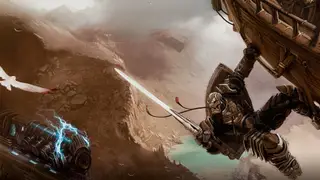
Across Eberron: Convergence Manifesto
Welcome to Convergence Manifesto — a campaign set in Eberron, a world where magic does the work that coal and steam do elsewhere, where five nations spent a century killing each other and stopped only because something worse came along, and where forces older than human memory are still making moves that won't be visible for generations. This page covers what you need to know before we start. If the setting grabs you and you want more, this wiki will provide everythign you need.
The Short Version
Eberron is a fantasy setting that runs on noir logic and pulp adventure. The technology is magical rather than mechanical — bound elementals instead of steam engines, arcane lanterns instead of gas lamps — but the resulting society looks more like the 1920s than the Middle Ages. There are newspapers, insurance companies, labour disputes, and organised crime. But fret not, there are also dragons, demons, dungeons, and dead gods.
A continent-spanning kingdom called Galifar held civilisation together for a thousand years. Then the king died, his children went to war over the throne, and that war lasted a hundred and two years. It ended two years ago — not because anyone won, but because an entire nation was annihilated overnight by an unknown force and everyone got scared enough to sign an armistice. The peace is two years old but nobody trusts it to last. Your character lived through this, or grew up in its aftermath. The Last War isn't backstory; it's yesterday.
The campaign starts in Sharn, the biggest city on the continent — a vertical sprawl stacked miles high, where the wealthy float on clouds of solid magic and the desperate rot in permanent shadow underneath. It won't stay in Sharn. The conspiracy your character stumbles into will pull them across borders, through manifest zones where other planes of existence bleed into the world, and into conflicts between factions whose agendas are measured in centuries rather than election cycles. But it starts with a city, a sealed vault, and a job that sounded simple.
How Magic Works Here
This is the single most important thing to understand about Eberron, and it's the thing that separates it from every other D&D setting: magic is infrastructure.
Although in terms of aesthetic Eberron resembles turn of the century technology, it never had an industrial revolution because it didn't need one. What other worlds achieved through steam and gunpowder, Eberron achieved through the systematic, widespread application of arcane energy. The result is a society that runs on magic the way ours runs on electricity or gas — not as something rare and wondrous, but as a utility. A service. A trade.
Lightning rail carriages travel the continent on conductor stones, linking capitals in days. Airships cross the sky held aloft by bound elementals spinning in dragonshard rings. At street level, everbright lanterns light the roads, speaking stones carry messages across districts, and the morning broadsheet comes off a press powered by minor cantrips. Hospitals use healing magic with standardised pricing. Banks ward their vaults with abjuration. Locksmiths inscribe arcane locks on front doors the way ours install deadbolts.
The people who make this work are not wizards. They are magewrights — working-class spellcasters with narrow skill sets, guild memberships, and shift schedules. The magewright who maintains the lanterns along a Sharn thoroughfare has more in common with an electrician than with Gandalf. She clocks in, does the job, goes home. Magic here is a trade. It has apprenticeships, licensing requirements, safety regulations, and wage disputes.
The average citizen of Khorvaire may never cast a spell in their life, but they ride magic to work, eat food grown under its influence, and read by its light every evening. They don't understand how it works any more than you know how to assemble a radio or build a car. They don't have to. They flip the switch.
This matters for Eberron because it means magic is everywhere — woven into the economy, the law, the architecture, the daily routine of every person your character meets. It also means that when magic goes wrong, or when someone figures out how to weaponise the infrastructure that an entire civilisation depends on, the consequences aren't theoretical. Pull the wrong thread and the towers come down.
The War That Broke the World
The Kingdom of Galifar collapsed into civil war in 894 YK when King Jarot died and his children couldn't agree on succession. What followed was a hundred and two years of continental warfare — shifting alliances, generational grudges, atrocities committed by every side, and a grinding devastation that reshaped the map and displaced millions.
Every nation fought. Every nation committed acts it now pretends to regret. Karrnath raised its dead as soldiers to be sent back to the warfront. Thrane's church launched purges against nonbelievers in the name of divine mandate. Aundair weaponised its arcane academies and perfected the art of mass slaughter with war magic. Breland built war machines and developed a premier intelligence agency that is feared across the continent. Cyre — the nation that arguably had the strongest claim to the throne — was ground down from every direction by neighbours until the unimaginable happened.
In 994 YK, the nation of Cyre was annihilated in a single day by an unknown force. A wall of dead-grey mist rolled across the country and destroyed everything within its borders, slaughtering millions, glassing landscape, unleashing uncontrolled wild magic across an entire country — cities, farmland, armies, civilians, geography itself. What's left is called the Mournland: a blighted waste where the dead don't decay, healing magic fails, and the landscape behaves according to rules nobody has identified. Millions of people died. The survivors — those who happened to be beyond the borders when the mist came — became refugees overnight, stateless and unwelcome in the nations that spent a century trying to conquer their homeland.
The event is called the Mourning. Its cause is unknown. No faction or nation has claimed responsibility. No investigation has produced a conclusive answer. Every government on the continent is quietly terrified that whatever did it could be replicated — or that it could happen again on its own.
Two years later, the surviving nations signed the Treaty of Thronehold. Not because they'd resolved their differences, but because continuing the war meant risking another Mourning. The treaty recognised twelve sovereign nations, mandated the dismantling of House Cannith's warforged production facilities, and granted warforged — magically constructed soldiers built for the war — the legal rights of sentient beings.
The peace is two years old. It is fragile, performative, and distrusted by nearly everyone who signed it. Veterans crowd the streets of every major city looking for work. Cyran refugees live in walled districts and converted barracks, resented by the populations they've been dumped on. Espionage services that expanded during the war never contracted afterward. Every government maintains contingency plans for a conflict most of them believe is inevitable.
Your character grew up inside this. The Last War shaped everything — where they're from, who they lost, what they believe about the people across the border, and what they think about the peace that's supposed to have replaced it.
The Feel of It
The aesthetic is fog and gaslight. Newspaper ink and arcane static. Rain on bridges a thousand feet above the ground while an airship passes overhead trailing bound lightning. A healer mends a shattered bone with magic and the clinic sends you a bill. A veteran of thirty years works as a tavern bouncer because the skills that kept him alive don't translate to anything the peacetime economy values. A warforged — built for war, freed by treaty, now legally a person — stands on a street corner trying to work out what to do with a life that wasn't supposed to include the concept of after.
Nobody's hands are clean. There is no nation of pure paladins and no empire of darkness. Every institution operates in moral grey. The Church of the Silver Flame genuinely protects the innocent from supernatural threats — and it launched a purge that killed thousands of lycanthropes, and many innocents were not infected in the collateral. The dragonmarked houses provide essential services no government can match — and use that dependency as leverage to operate above the law. The Boromar Clan runs organised crime across Sharn's lower wards — and provides stability, employment, and protection in districts the city government has abandoned.
The stakes are personal before they're cosmic. Your character's debts, grudges, and relationships matter before any grand conspiracy does. The best Eberron stories let the personal and the political converge on their own, so that by the time the larger threat becomes clear, you care about the people it's going to hurt.
The answers are rarely clean. The villains are rarely obvious. And the line between the two shifts depending on where you're standing and who's paying you to stand there.
Key Terms
A few words that will come up immediately:
Eberron — The world. Also, in mythology, the Dragon Between — one of three progenitor wyrms whose body became the natural world itself.
Khorvaire — The continent where the campaign takes place. Roughly comparable in size and diversity to Europe. Home to over a dozen nations, the dragonmarked houses, and the wreckage of a century of war.
Galifar — The kingdom that unified most of Khorvaire roughly a thousand years ago. Its collapse into civil war is the defining event of recent history. When people talk about "the old kingdom" or "before the war," they mean Galifar.
The Five Nations — Aundair, Breland, Cyre, Karrnath, and Thrane. The five great provinces of old Galifar, each once ruled by a scion of the royal Wynarn bloodline. Now independent states, still defined by the war that separated them. Cyre no longer exists in any functional sense.
The Mourning — The unknown catastrophe that destroyed Cyre in 994 YK, four years ago. Its cause is the most important unanswered question in the setting. Nobody knows. Everybody's afraid.
The Treaty of Thronehold — The armistice that ended the Last War in 996 YK. Recognised twelve sovereign nations. Freed the warforged. Didn't resolve anything, just established the terms under which everyone agreed to stop killing each other for now.
998 YK — The current year. "YK" stands for Year of the Kingdom, counting from Galifar's founding. The war ended two years ago. The treaty is still fresh. The scars aren't.
Dragonmarked Houses — Thirteen families who bear hereditary arcane sigils — dragonmarks — that grant specific magical abilities. Each house has built a commercial monopoly around its mark's specialty: Cannith (manufacturing), Jorasco (healing), Lyrandar (transport), Kundarak (banking), and so on. They are not governments. They are something more powerful — corporations that predate every nation on the continent and will almost certainly outlast them.
Sharn — The City of Towers. Largest city on Khorvaire. Built above a manifest zone that allows its towers to reach impossible heights. A vertical sprawl where wealth, poverty, crime, politics, and magic stack on top of each other in a miles-high column. This is where the campaign starts.
What Next?
That's the world. Next step is building a character — figuring out where they come from, what the war did to them, who they owe money to, and why they're on an airship heading for Sharn with someone else's secrets in the hold. And even more useful: knowing what your character knows.