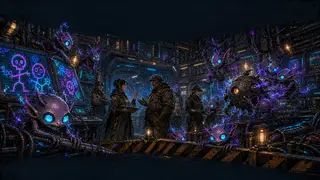
Event Type: Station Treaty / Tech Fey Concord
Junction 7 is why some stations have “Do Not Feed the Gremlins” signs written into their building code.
A few decades after the Kestral Spindle Twelve‑Minute Blackout, botnib infestations were no longer dismissed as simple glitches; they were recognized as Rift‑born tech fey shaped by Undersong currents. One major Inner/Outer hub—name redacted in most public records, known in guild slang simply as “the Junction Station”—found itself saddled with a particularly stubborn nest in Power Junction 7, a critical crossroads for trunk lines feeding docks, transit rings, and life‑support sectors.
At first, the station’s engineering guild did what everyone did in those days: purge attempts, hard reboots, and controlled burn‑outs. But every time they cycled Junction 7, the botnibs re‑coalesced from residual glitch patterns and scorched components, a little more territorial and a little more cunning about dodging standard countermeasures. Sabotage ops only made matters worse, provoking retaliatory mischief—mild brownouts in adjacent sections, tampered diagnostics, tools that failed at exactly the wrong moment. When a third purge nearly cascaded into a station‑wide power event, guild leadership conceded the awkward truth: the gremlins weren’t leaving.
By then, concepts like Undersong conservancies and “negotiated anomaly management” were circulating, especially after events like the Verdant Armistice, where factions learned to live with planar bleed rather than trying to erase it. Drawing on those precedents, the local guildmasters, a Chronologist liaison, and a Viridian‑aligned Undersong consultant proposed something radical for hardware gremlins: a formal concord. After weeks of cautious experiments—offering low‑priority boards as “toys,” observing what the botnibs defended most aggressively, and testing whether they attacked unbadged devices—the Junction 7 Gremlin Concord was signed:
The guild would dedicate a ring of non‑critical systems in Junction 7 as a permanent gremlin playground—redundant status screens, diagnostic subnets, sacrificial test boards, light strips, and maintenance drones the nest could reconfigure at will.
In exchange, the botnibs would leave core trunks and life‑support controls untouched and would use their techsense and digital telepathy to act as living intrusion‑detection, swarming any unauthorized devices or tampering attempts that crossed preset “no‑play” boundaries around vital circuits.
Subsequent station logs show a dramatic drop in unexplained outages near Junction 7 and a spike in caught intrusions, from black‑market tap attempts to sabotage linked to rival factions. For the Chronologists and engineering guilds, this became the first formally documented botnib–guild treaty, the Junction 7 Gremlin Concord, and a turning point in how tech fey were treated: not only as hazards, but as potential partners in a carefully bounded, neon‑grubby ecology of the Rift.
Gremlin Playground Zone: A defined area of the station is a botnib sanctuary. Within it, tech behaves unpredictably but non‑lethally; outside it, PCs gain bonus defense vs. tech sabotage because the gremlins rapidly dogpile hostile code or devices.
Concord Tagging: Authorized devices carry Concord glyphs or handshake routines. Unmarked tools and stealth drones risk immediate botnib attention—treat as automatic detection or an escalating hazard.
Anomaly Reputation Track: PCs can earn or lose “Gremlin Concord” favor; honored guests can request botnib help (e.g., scrambling a pursuer’s sensors), while treaty‑breakers find their own kit “playfully” disassembled at the worst time.
Primary Functions in Campaigns:
Legal and cultural precedent for bargaining with a botnib nest instead of exterminating it.
An in‑universe explanation for why some hubs classify botnibs as “protected hazard fauna” or list them on anomaly registries rather than pest logs.
A model for hybrid security design: conventional firewalls plus Rift‑born gremlin IDS.
-
Significance
Negotiation Scenario: PCs arrive at a station where Junction 12 is sliding toward a repeat of Junction 7—persistent nest, failed purges, rising accidents. The guild wants to recreate or adapt the Concord, and the party mediates between anxious engineers, conservative Chronologists, jittery dock unions, and a nest of curious gremlins.
Legal Counsel & Arbitration: As Undersong conservancies like the Covenant of Seven Seasons gain influence, PCs might be hired as expert witnesses or field investigators in disputes over whether a particular gremlin nest qualifies as protected “hazard ecology” under precedents like Junction 7.
Gremlin Whisperer PC: A party technomancer, Navigator, or Viridian bio‑tech can leverage the Concord tradition to establish personal pacts with nests, trading shiny code, music loops, or dedicated toys for on‑call security or minor on‑the‑fly hacks.
Aftermath
Among engineering guilds, Junction 7 is now listed alongside Kestral Spindle in training briefs, but as the “other way this can go”—not a blackout, but a managed coexistence. Technical standards and best‑practice docs begin including optional annexes for “botnib‑aware design”: building in non‑critical play rings, clearly demarcated from core trunks, and leaving enough “noise” in the system that tech fey have somewhere harmless to express themselves.
For Chronologists, the Concord reinforces the doctrine that some anomalies are best handled as ecological features of time and tech, not enemies to be erased at any cost. It complements cases like the Verdant Armistice: in both, the Guild ultimately endorses a fenced‑off wildness—zones where the Rift’s weirdness is allowed to exist under treaty, in exchange for safeguarding the broader temporal and logistical network.
Undersong conservancy advocates, especially Viridian‑aligned groups, point to Junction 7 as proof that even hardware‑bound manifestations of the Rift can be folded into living systems. Over time, some stations register specific nests as “hazard fauna”, protected by local ordinances: you can’t just purge them without guild sign‑off and conservancy review, especially if they are performing recognized ecological services like intrusion detection or glitch‑drain in high‑risk sectors.
The Junction 7 Gremlin Concord marks the moment Starfall’s station guilds stopped asking “How do we kill the gremlins?” and started asking “What if we gave them a playground and a job?”—turning a chronic hazard into a strange, twitchy ally in the ongoing fight to keep lights on against the Rift.
GD‑30.9.44 Hollow 29