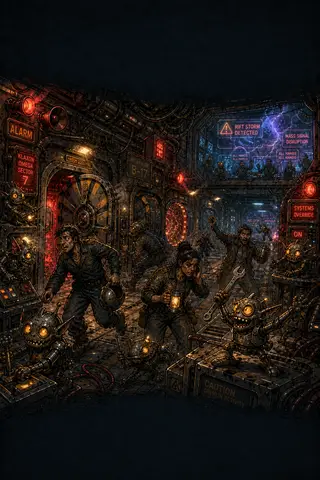
Event Type: Relay Station Hazard / Clangit Festival Uprising
In the late post‑Hegemony / Principality era, Inner Sphere traffic still depended on a web of aging relay stations—propped up by patchwork repairs, underfunded refits, and the assumption that “if it hasn’t failed catastrophically yet, it probably won’t.” One such relay, sitting on a busy comms and navigation node near the core, was notorious even by Inner Sphere standards for deferred maintenance and overextended duty cycles: alarms taped over, bypassed safeties, and sensor loops that had not been recalibrated since before the last Commission audit.
On GD‑29.4.19, a minor Rift storm brushed the station’s outer hull, dumping a charge of psycho‑reactive static into every sensor loop and emergency line at once. Instead of tripping fail‑safes in discrete sectors, the surge tickled every klaxon, status repeater, and environmental alert in the same heartbeat. To the resident **clangit clans—gremlins of metal stress, mechanical rhythms, and analog thresholds—this felt like a blessing: a whole station’s worth of toys going off at once.
They treated it as a festival. Working in loose bands across the relay’s spine, clangits began chaining Mechanical Trickery into a rolling, coordinated cacophony:
Hatches that slammed, cycled, and then politely re‑latched in perfect sync with alarm pulses, forcing crew to stop and re‑check seals every few meters.
False decompression alerts that fired only in already‑safe corridors, sending people scrambling into helmets and suits for no reason while actual locks and bulkheads held firm.
Entire banks of warning klaxons running in precisely timed cascades, so that just as one sector’s alarms were silenced, a different section spun up—never quite enough to justify a full evac, but impossible to ignore.
For nearly six straight hours, the relay existed as a kind of living siren engine: lights strobing, doors opening and shutting on beat, environmental panels flipping between normal and hazard states like a visual chant. Crews chasing “the real problem” found only pranks—systems that looked briefly dangerous, then snapped back to nominal the moment they arrived.
By morning, the station was physically intact, but its people were not. Sleep‑deprived Navigators missed their tight communication windows, schedulers blew contracted relay slots, and a much‑touted diplomatic summit had to be aborted because both delegations refused to disembark into “that screaming tin can.” In a single night, the relay’s already‑wobbly reputation cratered.
The event entered local legend as “The Night of a Thousand Alarms.” In the political blowback that followed, station command finally secured budget for a long‑overdue refit—and, more quietly, wrote a new role into the operations roster: a Gremlin Liaison charged with keeping local clangits looped into upcoming work and ritual “celebrations” instead of letting them improvise system‑wide concerts on their own.
A template for clangits as analog gremlins—they don’t hack software, they abuse sensors, doors, and physical alarms.
A non‑lethal but exhausting station event: the threat is attrition, miscoordination, and social fallout, not hull breach.
A precedent for the Gremlin Liaison position, explaining why some modern stations have staff (or PCs) who formally negotiate with tech fey instead of just hunting them.
Primary Functions in Campaigns:
Treat the event (or a replay of it) as a multi‑stage environmental hazard that inflicts fatigue, penalties to concentration, and mounting social/contract complications instead of direct HP damage.
Each “cycle” of alarms triggers skill checks (Engineering/Computers to correctly triage alerts, Perception to spot harmless patterns, Diplomacy or Intimidation to keep civilians calm). Failure doesn’t kill anyone, but ratchets up political and economic consequences.
A Gremlin Liaison feat/background could give PCs bonuses when interacting with clangits, plus limited influence over when and where they direct their “celebrations.”
The Night of a Thousand Alarms is a reminder that even neglected infrastructure and half‑forgotten gremlin clans have a voice—and if you don’t listen to them in meetings, they’ll speak to you through every siren on the station.
Significance
Crisis Management Scenario: PCs are brought in mid‑event—either as on‑station crew or emergency contractors—to restore operational calm without shutting down the relay. The challenge is building trust with the clangits (or at least understanding their “festival logic”) while also satisfying impatient clients and diplomats.
Refit Negotiation: In the aftermath, engineers and politicians argue over how much budget goes to hardening systems versus formalizing a Gremlin Liaison office. PCs might lobby on either side, design new clangit‑safe alert protocols, or help write the first liaison charter.
Cultural Exchange: A later campaign could feature a Gremlin Liaison PC serving as guide and interpreter for visiting dignitaries during a planned clangit “alarm parade”—a ritualized, scheduled echo of the Night used to commemorate the refit and remind management what happens when they ignore the ring’s spirits.
Aftermath
In Inner Sphere operations circles, the Night of a Thousand Alarms becomes shorthand for “what happens when you ignore maintenance and station‑spirit politics at the same time.” Relay captains cite it when begging for parts, and auditors invoke it when justifying surprise inspections of alarm systems and emergency routing.
For clangits, the event is remembered as a victory—a demonstration that they can force human schedules to match station reality by making neglect too loud to sleep through. Some Principality‑era relays still mark its anniversary with low‑key “alarm walks,” where crew and liaison teams deliberately cycle non‑critical alerts in choreographed patterns while clangits swarm and “approve” the work.
Institutionally, the creation of a Gremlin Liaison slot on the relay’s org chart influences later Commission charters and guild best practice documents: stations with known tech fey populations are encouraged—or required—to designate a formal point of contact responsible for monitoring anomaly mood, planning safe vents for “festivals,” and looping gremlins into scheduled maintenance. Over time, this helps shift clangits from purely adversarial pests to semi‑recognized stakeholders in industrial ecology, especially on older rings and relays where they are as much a part of the infrastructure as the bolts.
GD-29.4.19 | Midnight 24