Event Type: Extended Occupation / Resistance Incubation
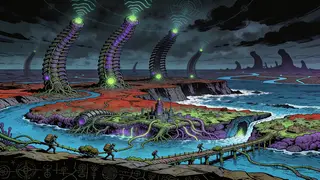
In the wake of the First Drowning, the ocean world of Tan’Kuyu settles into a grim equilibrium under Void Leviathan oversight. Over several decades, Leviathan taskmasters impose a deliberately engineered “ecology of obedience”: entire river systems are culled or redirected, spawning grounds are dredged into nutrient pits, and whole amphibious populations are forcibly relocated to more “efficient” basins.
Along key coasts and archipelagos, the Leviathans raise towering organic spine‑towers—vast, flexible growths that function as living signal masts back into the Rift, pulsing telemetry and psychic command‑threads to whatever Leviathan intellects lurk beyond realspace. These structures become both physical landmarks and spiritual wounds, visible from any surviving Tanyon‑Unin city‑reef as reminders that Tan’Kuyu now speaks more to the abyss than to its own people.
On the surface, clan structures buckle under quotas and forced labor schedules. Beneath and between, Tanyon‑Unin ingenuity survives underground and undersea. In partially flooded caverns, abandoned cisterns, and pressure‑stabilized reef hollows, they carve out hidden air‑caverns, drowned script caches, and clandestine Tanu cant—a coded sublanguage woven into gesture, tide‑rhythms, and carved marks. Along these secret circuits, coastal clans quietly synchronize resistance myths and survival protocols, even though they still wield little more than iron, wood, and muscle against their occupiers’ bio‑industrial might.
Over the course of GD‑31 through GD‑36, the Long Occupation of Tan’Kuyu becomes less about open rebellion and more about cultural encryption: preserving stories, techniques, and networks that will outlast the present Leviathans, no matter how many shorelines are rewritten.
Engineered Obedience
The Leviathans’ “ecology of obedience” isn’t metaphorical—it’s literal ecosystem redesign. By culling rivers, relocating species, and reshaping coastlines, they try to biologically condition Tanyon‑Unin communities into dependence and compliance.
Spine‑Towers as Planetary Nervous System
The organic tower‑spines are living antennas to the Rift, suggesting each occupied world is a node in a larger Leviathan sensor and command network. Destroying one is both strategic sabotage and a quasi‑religious act of defiance.
Hidden Culture Under Pressure
Tanyon‑Unin resistance at this stage is subterranean and subtidal: script caches etched where only divers can reach, encoded songs sung off‑beat to confuse Leviathan monitors, and Tanu cant that lets them coordinate under their overlords’ sensory thresholds.
Primary Functions in Campaigns:
Background for Tanyon‑Unin PCs: Explains why modern Tanyon‑Unin often have deep traditions of coded speech, secret meeting‑places, and ritualized sabotage, even in peacetime.
Model for Other Occupations: Provides a template for how Void Leviathan control plays out over decades, useful if you want similar arcs on other worlds (terraformed rivers, quota cities, bio‑signal towers).
Framework for Low‑Tech Resistance Play: Justifies campaigns where PCs are tech‑underclass insurgents relying on environment, language, and community rather than advanced gear.
The Long Occupation of Tan’Kuyu turns a single catastrophe into a generational crucible: Void Leviathans sculpt land and sea into obedience, while the Tanyon‑Unin quietly sculpt language, myth, and stone into the tools they will one day use to break free.
Significance
Cant and Code: PCs can leverage Tanu cant and encoded reef‑marks to communicate, smuggle, or coordinate without tripping surveillance—granting bonuses on Deception, Stealth, or Networking checks when used among Tanyon‑Unin communities.
Cavern Sanctuaries: Hidden air‑caverns and script caches make perfect safehouses, shrines, or data‑vaults, serving as hubs for downtime, research, or clandestine diplomacy between surface collaborators and deep‑water holdouts.
Memory as Weapon: Tanyon‑Unin storytellers use occupation epics to train new generations in pattern recognition and subversion, which you can treat as in‑world justification for high Lore skills or unusual tactical acumen among seemingly low‑tech communities.
Aftermath
The Long Occupation of Tan’Kuyu teaches the Tanyon‑Unin that survival under overwhelming force is a matter of culture, not just arms. Clan identity shifts from simple shoreline affiliation to membership in encoded networks—those who can read the right cuts in rock, feel the right tide‑rhythms, or understand specific song‑variations belong to the “true people,” even if they labor under Leviathan oversight by day.
In later eras, Tanyon‑Unin politics and religion remain shaped by this memory: deep suspicion of any regime that reshapes rivers or coasts for efficiency, reverence for hidden reefs and caves as sites of ancestral defiance, and a tendency to structure resistance cells along tide and cavern lines rather than the more obvious clan banners overlords can see.
GD‑31–GD‑36
This is the slow-burn horror phase of Tanyon‑Unin history: decades where the Leviathans don’t just conquer Tan’Kuyu—they reengineer its ecosystems and social fabric, while resistance culture ferments below the tide line.