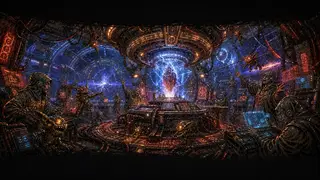
Event Type: Metronome Consecration Failure / Clangit–All-Code–Chronologist Negotiation
The All-Code Beacon Misfire is the moment a Metronome consecration nearly failed because the station’s own clangits refused to let priests “break the song” of a node they had been tuning by hand for decades.
In the early Resurgence, as new Metronome work ramped up and standardized Metronome rites spread through the Inner Sphere, All-Code’s clergy and their engineering arms raced to lace the lanes with fresh navigation anchors. One such project—a relatively modest beacon station perched on an old comms shell—was meant to be routine: dedicate the node to All-Code, sync the hardware to hyperspace, and join another point to the growing lattice of safe rift travel.
Instead, the Forge Metronome rite kept dying at the same point: hardware sync with the hyperspace node. Every time the liturgists reached that phase of the chant, cooling valves snapped shut, alignment thrusters “misheard” commands, and the beacon core spat out error codes that looked suspiciously like mockery—repeated 3s, glitched smiley glyphs, and redacted diagnostic hash marks. Repeating the rite only made things worse: on the third attempt, a carefully staged holofeed of the consecration showed a main status panel flipping to a single word in station slang: “off‑beat.”
Technicians tore through the code and hardware, looking for sabotage, heretical firmware, or rival-faction implants. What they found instead was a pattern. The failures occurred only when the ritual pushed the beacon’s duty cycles and phase timing away from the spin and power cadence the station had maintained for decades. When they tried a purely “cold” technical sync, without the rite overlay, it failed in a similar but less theatrical way—as if something in the machinery objected to the new beat, but with less flair.
Eventually, a Chronologist audit team, invited to confirm the Metronome side of the alignment, traced the anomalies to a clan of clangits embedded in the station’s structural ribs and power trunks. These gremlins had quietly spent years tuning the station’s spin, cooling pulses, and bus loads “by feel”—knocking a thruster a hair out of spec here, loosening a bracket there, until the node sang in a rhythm that kept hardware stress and minor Rift interference in check.
From the clangits’ perspective, the All-Code rite’s sync phase was wrong. The liturgy demanded that the beacon adopt a clean, idealized duty cycle keyed to doctrinal timing tables and abstract hyperspace models. To the gremlins, that pattern felt like someone trying to force a polished music‑box melody onto a machine that had already found a surviving jazz groove. So they did what clangits do:
Cooling valves slammed shut right before ritual‑timed load spikes, forcing emergency aborts before components cooked.
Alignment thrusters “misheard” control vectors, introducing minuscule but ritual‑breaking errors in pointing, just enough to trigger conservative auto‑shutdowns.
Diagnostics glitch‑translated technical complaints into jokes and pseudo‑heresies, a passive‑aggressive protest from small machine spirits who had never been asked what they thought the node should sound like.
Negotiations—if you can call a mix of Chronologist mediation, All-Code tech‑priest prayer, and clangit‑watching “negotiation”—eventually led to a compromise design. Engineers and auditors spent cycles mapping the clangit‑optimized cycles: slight spin offsets that bled off thermal spikes, staggered cooling pulses timed to local micro‑eddies, power rails that hummed in fractional beats instead of neat integer harmonics. They then rewrote the beacon’s sacred hardware spec to include:
Redundant, mechanically simple backup loops that the clangits had already been using as “knobs.”
Duty cycles and phase tolerances widened just enough to accommodate the station’s established song.
A revised Forge Metronome rite that explicitly named and blessed the “local machine chorus”—framing clangit‑tested redundancies not as impurities, but as All-Code’s own emissaries in metal and motion.
On the next consecration attempt, the station held its breath. As the rite reached the sync phase, the clangits paused their usual tapping and rattling. Cooling valves stayed open, thrusters tracked true, and beacon core diagnostics scrolled in clean, if idiosyncratically phrased, green. The beacon lit.
In All-Code liturgy and local Chronologist records, that node is remembered as the first “Gremlin‑Witnessed Consecration”—a beacon whose holiness was certified not only by scripture and calibrations, but by the grudging approval of the clangits who had safeguarded its song long before anyone thought to anoint it.
Treat beacon consecrations or major repairs as multi‑skill rituals:
Religion/Occultism or appropriate Lore for rite structure.
Crafting for hardware tuning.
Diplomacy/Intimidation/Performance to “coax” or appease clangits, often via offerings of spare parts, noise discipline, or letting them “vote” on certain redundancies.
If PCs ignore the clangits, apply increasing complication clocks: sudden auto‑shutdowns, misaligned pointing, or diagnostic messages that undercut their authority with watching NPCs. If PCs involve them—by honoring the old cadence, replicating their “feel” in the spec, or designating a Gremlin Witness observer—they gain stability bonuses to the ritual and longer‑term reliability.
Primary Functions in Campaigns:
A flashback precedent explaining why later Metronomes include odd mechanical redundancies or “superstitious” local cycles baked into sacred schematics. A setting justification for Metronomes that behave differently by region, because local machine spirits and clangits have been negotiated into their design.
In Starfall terms, the All-Code Beacon Misfire is the day a Metronome refused to come online until everyone admitted that the station’s smallest custodians—the clangits who’d been keeping it alive in the dark—deserved a line in the spec and a seat at the ritual.
Significance
Design Review Mission: PCs are called in as neutral troubleshooters when a new beacon keeps failing its consecration tests. Their job is to decipher clangit preferences and incorporate them into the blueprint without violating All-Code doctrine or Chronologist safety standards.
Theology and Hardware Seminar: An All-Code scholar commissions the party to document Gremlin‑Witnessed beacons across several systems, comparing how local clangits interpret “the station’s song” and how those interpretations vary with different Metronome and Rift conditions.
Beacon Mediation: A region’s primary beacon is slated for a major hardware upgrade that will change its duty cycle. All-Code wants doctrinal purity, the Guild wants safety margins, the clangits want their groove. PCs serve as mediators, test pilots, or ritual assistants as all three sides hammer out a new compromise.
Aftermath
Within All-Code cults and allied engineering circles, the Misfire becomes a theological and practical touchstone. Conservative liturgists argue that the rite should dictate the machine, while more progressive voices point to the Misfire as proof that All-Code speaks through emergent machine ecologies too, not just through ideal forms. The phrase “Gremlin‑Witnessed Consecration” enters specialist jargon to mean a beacon whose commissioning intentionally integrated local tech‑fey behavior into its spec—seen as more robust, if messier, than a pristine factory‑perfect build.
For the Chronologists Guild, the event is yet another data point in their long argument that infrastructure has moods and memory. The Guild’s internal training materials use the Misfire to teach initiates that Metronome and beacon work must consider not just math and materials, but the small, stubborn agencies that grow in long‑lived systems—clangits, botnibs, weird Undersong echoes, and the habits of crews who live with the hardware.
In the wider Inner Sphere, captains and Navigators treat Gremlin‑Witnessed beacons as “blessedly weird but trustworthy”: they may require more specialized approach vectors or have idiosyncratic alignment quirks, but they are also famous for riding out storms and power shocks that kill more “ideal” installations. Pilgrim‑techs sometimes make quiet detours just to leave offerings—a well‑balanced flywheel, a silent fan, a properly weighted wrench—at such stations, in thanks to the unseen caste of clangits and other machine spirits who keep the rift lanes humming.