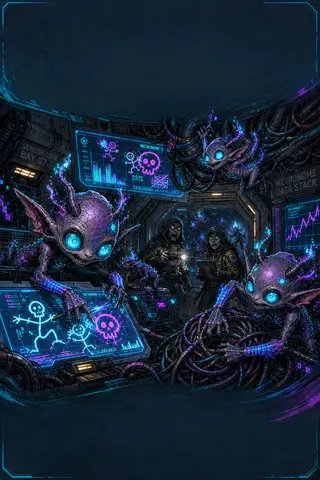
Event Type: First Documented Tech Fey Infestation / Survey Ship Anomaly
The Glass Serpent was a mid‑Resurgence survey cruiser, contracted to map medium‑risk Rift corridors for future trade lanes and Metronome baselines along a sparsely charted Outer/Frontier interface. Its mission profile was routine for the era: long, cold transects through psycho‑reactive currents, sensor masts bristling with quantum interferometers and Rift‑flux cameras, Chronologist observers watching for temporal drift. The crew expected the usual hazards—taint, static ghosts, maybe a brush with a minor Rift‑burg.
Midway through its tour, the Serpent’s sensor suites began to misbehave in a deeply specific way. Live Rift telemetry—normally rendered as color‑coded flows and density plots—suddenly sported laughing stick‑figure sprites, little animated glyphs dancing along flux lines, re‑labelling hazard zones with childish scrawl and looping “commentary.” At first, navigators blamed a UI bug or bored techs. Then the ship’s diagnostics reported unauthorized firmware rewrites in three junction bays, and the Chronologist observer found that entire chunks of Metronome return data had been “artistically redacted”—replaced with doodles, riddles, or looping giggles in sensor‑log audio.
When Glass Serpent limped back to dock and technicians cracked her access trunks, they found three junction bays rewired into a gremlin nest. Conduits were braided into hammocks and climbing frames; maintenance drones had been partially repurposed into “toys”; and whole banks of logic cores were overgrown with shimmering, semi‑corporeal sprites that flitted between cable runs, leaving behind corrupted but oddly whimsical code. It was the first formally documented case of a botnib infestation—Undersong‑aligned “tech fey” that had ridden Rift‑space micro‑cyclones straight into a survey ship’s nervous system and decided to stay.
The investigation forced the Chronologists Guild and Azure Archivists to concede that Undersong micro‑cyclones could manifest as persistent, semi‑sentient gremlins in realspace hardware. Glass Serpent’s Metronome data was declared partially compromised; her navigational outputs had to be reconstructed from analog backups and off‑ship tapes. The ship herself went through an extended, highly public decontamination and refit, and “botnib checks” became a standing joke—and then a serious checklist item—across Rift‑mapping crews.
The Glass Serpent Survey Incident is how Starfall’s galaxy learned that some of the Rift’s smallest jokes can have the biggest consequences—turning harmless “sprites” into a permanent line item in every serious survey ship’s budget, checklist, and superstition.
Botnib Swarm / Tech Fey Hazard: A low‑ to mid‑level hazard or creature that targets electronics, targeting arrays, and data logs rather than HP first—imposing misfires, false readings, and narrative complications (e.g., adding bogus contacts to the tactical map).
Gremlin Baffles: Starship upgrade or feat that gives a bonus vs. botnib/tech‑fey effects, at the cost of extra mass, power draw, or calibration time.
Analog Backups & Ritual Quarantine: Downtime actions that let PCs lock in clean sensor baselines, granting rerolls or resistance if an encounter tries to corrupt their nav data later.
Primary Functions in Campaigns:
Justifies “gremlin” creatures/hazards aboard ships that spend time in Undersong‑adjacent Rift currents.
Provides a canonical reason why modern survey vessels have gremlin baffles, analog backups, and ritualized sensor quarantines.
Gives you a ready‑made hook for mysterious sensor anomalies that are more playful than purely malignant—until ignored.
Tech Fey as Undersong Echo
Glass Serpent proved that Green‑leaning Rift phenomena don’t just haunt forests and biospheres—they can colonize code and cable. Botnibs are the Undersong’s mischievous side, treating sensor lattices like hedgerows and junction bays like burrows. This reframes certain “software bugs” and system glitches as ecological events, not mere failures.
Chronologists vs. Chaos in the Wires
For the Chronologists, whose entire mandate relies on clean Metronome returns and stable timekeeping, the incident was a doctrinal shock. If a survey run can come home with its core data replaced by doodles and laughter, then sensor hygiene becomes as important as hull integrity—especially for Circuits already debating how much to embrace Rift phenomena.
Cultural Meme: “Serpent Laughing”
Within spacer and Navigator culture, “Serpent’s Laughing” becomes slang for any system that’s clearly haunted by more than just bad code. It’s an insult for sloppy survey outfits and a warning for green crews who tape over warning glyphs or joke about skipping quarantine steps.
Significance
Data Salvage & Forensics: PCs could be hired by Chronologists or Archivists to reconstruct Glass Serpent‑style corrupted archives, parsing what the botnibs erased, and what they highlighted with their “artistic redactions.” Sometimes, the gremlins circle or annotate information that matters to the Undersong more than to mortals.
Ethical Containment: Viridian Ascent or certain Devotional factions might argue that botnibs are a legitimate emergent lifeform, not mere contamination. PCs may have to negotiate non‑lethal removal or sanctuary networks for tech fey infesting older ships and stations, balancing safety with conservation.
Gremlin Whisperers: Niche specialists—engineer‑shamans, Navigator‑devoted, or Bnagil technomystics—claim they can bargain with botnibs to guide them away from critical systems and toward “toys” or sandboxed rigs. PCs may seek one out for a haunted ship, or a party member may grow into that role.
Aftermath
Following the incident, Rift survey standards across the Inner Sphere and serious Outer outfits changed. New‑build mapping vessels include:
Physical gremlin baffles: labyrinthine conduit architectures, sacrificial “play decks,” and hardware segmentation designed to trap or distract tech fey before they reach core systems.
Mandatory analog baselines: star charts, Metronome logs, and key engineering schematics are kept on hardened non‑networked media, so a single infestation can’t wipe everything.
Ritualized sensor‑core quarantine: crews perform both technical checks and codified “superstitious” rites—chimes, glyphs, synchronized resets—before docking and before pulling data into wider networks, blending Chronologist protocol with Navigator folk practice.
Within the Chronologists Guild, the Glass Serpent file is cited in training as a model for responding to the unexpected without declaring total loss: the mission was damaged, but not catastrophic, and the Guild turned the anomaly into better doctrine instead of an excuse for total denial. Among Navigators and spacer unions, it’s one more reason to demand hazard pay and real downtime after deep Undersong passes—“because nobody wants their brain implant drawing stick figures over Metronome returns.”
GD‑28.2.17 Friction 18