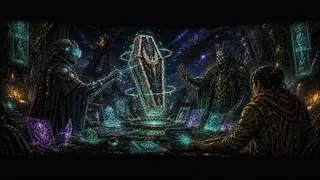
The Phoenix Archive Controversy is the moment the dead stopped being a distant policy question and became a stack of names, contracts, and broken promises you could scroll through line by line.
Event Type: Political / Ethical Data Leak – Necro‑Legal Archive Discovery
GD‑44.9.22 Parallax 11
Discovery in a Dead Ship
On GD‑44.9.22, an Azure Archivist survey flotilla picked its way through a derelict Vaelen command ship caught in a quiet eddy of Rift‑space. The vessel was a relic from the late Ascendancy—scarred by Synthetic Rebellion strikes, patched by Commission‑era scavengers, then finally abandoned when the Rift‑Storm Cataclysm made its patrol route lethal.
Deep in the armored core, behind redundant firewalls and ritual locks, the Archivists found something no one expected the Vaelen to be carrying: a sealed Babluse “Phoenix Archive.” The term, recovered from embedded glossaries, referred to a compact necro‑legal data‑vault designed to survive ship destruction, regime change, and even the fall of worlds.
When the Archivists finally cracked its outer lattice—carefully, under layers of containment—they found:
Thousands of Noāxol cut logs: Timestamped records of Quietus offers, refusals, deferrals, and “pending reconsiderations” for Babluse individuals all across Paxima and allied systems.
Undeath contracts for Babluse who never converted: Full legal templates, signed or prepared, outlining terms of second life—duties, estate transitions, service periods—attached to people who, according to Commission registries and diaspora genealogies, lived and died as mortals.
Someone, at some point in the Corpse Empire / Vaelen interaction, had been archiving who could have been made corpsefolk—and wasn’t. Whether as leverage, record‑keeping, or ideological trophy, the Phoenix Archive preserved an alternate history of undeath that never happened.
Word did not stay in Azure hands for long. A leak, a hack, or a deliberate “anonymous” transfer—accounts differ—pushed sanitized copies of the index into Babluse diaspora networks, Commission oversight committees, and quiet Noāxol crypt‑circles. The Phoenix Archive Controversy began.
Three Factions, Three Answers
The galaxy immediately split along familiar but newly sharpened lines over what the Archive meant and what to do with it.
Babluse Diaspora Communities
For scattered Babluse—especially those descended from survivors of the Halls of the Living and earlier Noāxol rule—the Archive landed like a meteor. Inside were:
Names of ancestors who refused Quietus and were recorded as such—proof that resistance existed and was (at least once) respected in law.
Names of relatives whose “consent” records didn’t match family stories, suggesting coercion, fraud, or post‑hoc fabrication.
Whole cohorts marked as “convertible assets” who never faced the choice on any remembered timeline.
Diaspora activists quickly argued that the Phoenix Archive should be used to:
Honor refusals by elevating those names as martyrs for first‑life autonomy.
Challenge current Corpse Empire and Commission practices that still blur the line between “offer” and “order” in Quietus‑style protocols.
Pursue reparations or legal remedies where ancestral consent was falsified or pre‑written.
From their perspective, the Archive was a smoking gun and a memorial, not a toy for Archivist curiosity or imperial leverage.
Azure Archivists
For the Azure Archivists, the Phoenix Archive was a perfect, poisonous treasure: a dense knot of historical truth, ethical hazard, and data‑temptation.
Their internal debates turned on questions like:
Does preserving and studying the Archive serve the higher logic of understanding undeath’s role in history, or does it turn real people’s near‑miss fates into case studies?
Should any entries be acted upon (e.g., using cut logs to verify or invalidate modern undeath claims), or is that a violation of archivist neutrality?
Can selective publication steer policy away from abuses without handing extremists a hit list of “should‑have‑been corpsefolk”?
Publicly, Azure spokesconstructs talked about “contextual preservation” and responsible curation. Privately, some Archivists saw the Phoenix patterning—who was offered, who refused, who was flagged as “pre‑asset”—as a blueprint for modeling how empires decide whose lives are “worth” extending. That kind of insight is irresistible to anyone trying to predict the next crisis.
Corpse Empire Agents
Within the remnant Noāxol / Corpse Empire, reactions were furious and split. Hardliners saw the Archive as:
A state asset stolen from a Vaelen protectorate ship (many Phoenix Archives were apparently entrusted to friendly or subjugated Vaelen fleets for redundancy).
A dangerous record of imperial inconsistency—moments when conversion was refused, delayed, or negotiated, weakening the narrative that second life is an unquestionable duty.
More pragmatic corpsefolk, especially Babluse necro‑bureaucrats shaped by the Halls of the Living Decree, recognized both threat and opportunity:
Threat: Diaspora lawyers could use the Archive to attack past conversions and demand structural reforms in current Quietus policies.
Opportunity: The Archive also documented times when Noāxol authorities respected refusal, offering a canon of precedents to argue that consent wasn’t a modern concession but a buried principle.
Within Noāxol crypt‑politics, factions argued over whether to:
Suppress the Archive by any means—including sabotage of Azure data‑nodes and targeted hits on key diaspora organizers.
Co‑opt it, selectively releasing entries that made the Corpse Empire look more humane than the Vaelen or Commission successor states.
Weaponize it as leverage: threatening to reveal Vaelen and Commission complicity in Quietus abuses unless modern powers recognize corpsefolk rights.
At the table, the Phoenix Archive Controversy gives you:
A clean hook for investigation, diplomacy, and ideology‑driven plots across multiple factions.
A way to put undeath ethics directly in front of the PCs via named, personal histories rather than abstract policy.
A lore excuse for Azure Archivist, Babluse, and Corpse Empire NPCs to share scenes in the same room.
Significance
Legal and Moral Arbitration: PCs act as third‑party mediators at a summit where diaspora councils, Azure representatives, and Noāxol envoys must agree on a framework for handling local Archive entries.
Personal Pilgrimage: A character discovers their own name—or that of a close ancestor—in the cut logs. Entire arcs can revolve around tracing what actually happened, confronting surviving officials, and deciding what justice looks like in a galaxy that has moved on.
Academic Intrigue: Universities, think‑tanks, and guild schools compete for curated access. PCs might be hired to escort a data‑shard, protect a controversial lecturer, or expose doctored “educational” versions of the Archive.
Aftermath
The Phoenix Archive Controversy reignites galaxy‑wide debate over undeath that had been slowly settling into cynical routine.
Three narratives surge:
Undeath as a Right: Activists argue that the Archive proves undeath has long been selectively gatekept, offered to some and denied to others for political reasons. They demand transparent, consent‑based access to Quietus‑style second lives for those who want them, not just for elites and favored servants.
Undeath as a Tool: Corporations and some Commission bureaucrats focus on the Archive as a data source for optimization—who makes the “best” corpsefolk, how long they served, what failure rates looked like. Their memos never say “tool,” but their hiring and policy shifts do.
Undeath as a War Crime: Survivors of the Shattering, Wraith‑sector atrocities, and forced conversions brand the Archive as evidence that mass undeath was essentially industrialized violation. To them, every cut log is an indictment. They push for international declarations treating non‑consensual conversion as a war crime, retroactively and going forward.
Babluse political movements fracture along these lines. Some see the Archive as a path to negotiated dignity with the Corpse Empire: codify consent, enshrine refusal, and salvage second life as a cultural right. Others insist that any system that turns people into “pre‑assets”—living or dead—must be dismantled, not reformed.
The Azure Archivists find their vaunted neutrality under fire. Their handling of the Phoenix Archive—what they redact, what they leak, which queries they grant—becomes a test case for whether the faction serves truth, control, or both.
Meanwhile, Commission regulators quietly panic. Their undead labor rules, Wraith Accord derivatives, and memorial practices all assume that the past is messy but mostly buried. The Archive says otherwise. If these templates for past abuses go fully public, entire industries might have to be rebuilt on new, consent‑driven terms. Or they might double down and try to bury the Phoenix data deeper, making the controversy even bloodier.
For ordinary people, the Phoenix Archive’s existence changes how they look at any corpsefolk in their lives—mentor, neighbor, employer, lover. Somewhere, there may be a file describing how close that person came to never being undead at all.
In Starfall’s canon, GD‑44.9.22 – Phoenix Archive Controversy is the point where undeath stops being just history’s shadow and becomes a live file, with every scroll of a cut log asking the same question: Who got to choose, who didn’t—and what are you going to do about it now?