GD‑14.8.2 Variance 4 – The First Worldship Compact
When Driftcaravans Chose Law Over Civil War
Salvage at a Collapsing Rift‑Burg
In the cycles after the Abnyau Eclipse Exodus, Tomenti worldships fan out along unstable Outer Sphere Rift routes, searching for safer currents, salvage, and allies.
One of the richest prizes is a collapsing Rift‑burg—a pocket of relative stability inside the Rift where stations and wrecks have fused into a jagged, multi‑layered habitat. As its anchoring anomalies decay, the burg’s structures begin to drift and break, shedding derelicts and relics that could sustain entire caravans.
Rival Driftcaravans—each made of several worldships with their own academies and councils—converge on this Rift‑burg.
One caravan claims prior survey rights and ancestral ties to Abnyau’s orbital lore.
Another insists on their Navigators’ charts and the urgency of their own starving city‑segments.
Skirmishes erupt:
Beacon jamming and misrouted convoy signals.
Threatening maneuvers between worldship escorts.
Boarding attempts framed as “inspections” that look a lot like raids.
The situation teeters on the edge of full‑scale Tomenti fleet war in one of the most dangerous environments imaginable.
Neutral Worldship as Meeting Ground
Recognizing that inter‑caravan war would mean mass death and the loss of their hard‑won Exodus gains, elders from multiple Driftcaravans call for a parley aboard a neutral worldship—a vessel with no direct claim on the Rift‑burg.
This neutral host:
Locks weapons and drive rings under convoy oath for the duration of talks.
Opens its academy halls and council chambers for formal debate.
Invites Navigators, theologians, and salvors from all involved caravans to attend.
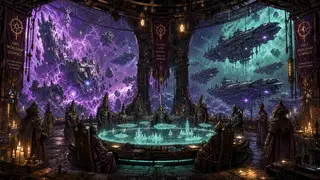
There, amid flickering Riftlight and the distant crackle of the collapsing burg, the elders begin drafting what becomes the First Worldship Compact.
Core Articles of the First Worldship Compact
The Compact is both practical and mythic, codifying how Driftcaravans will exist alongside each other:
Sovereignty of Each Worldship
Every worldship is recognized as a sovereign entity, with its own internal law and lineage traditions. Other caravans acknowledge these sovereign rights when dealing with shipboard disputes, refugees, and patrol boundaries.
Ban on Open Conflict Between Tomenti Fleets
The Compact forbids open warfare between Tomenti Driftcaravans and worldship fleets, declaring such conflict a violation of both Exodus duty and wind‑prayer doctrine. Disputes over salvage, routes, or doctrine must be resolved through councils, arbitration voyages, or agreed‑upon duels of representatives—not fleet engagements.
Formalization of Academies and Councils
Each caravan agrees to maintain academies (for Navigators, theologians, and scholars) and councils (representative bodies) as the recognized organs of governance. Academies handle interpretation of Compact law and route doctrine; councils manage salvage allocations, alliances, and internal justice.
These articles bind the Driftcaravans not into a single state, but into a shared legal and cultural framework that limits violence and elevates deliberation.
Why Tomenti Present a United Front Today
Over time, the First Worldship Compact’s principles are reinforced through:
Repeated joint councils when caravans face large crises—Rift anomalies, external invasions, or famine. Shared liturgies that treat the Compact as sacred text, recited alongside Exodus myths. Practice: caravans that violate the Compact face ostracism, refusal of aid, or combined sanctions from other worldships.
As a result, Tomenti today present a united front to outsiders:
External factions see Driftcaravans coordinate responses, speak through councils, and avoid public internecine conflict—even when internal philosophies clash sharply. Scholars and diplomats learn to approach “the caravans” as a bloc, while those in the know understand that beneath the unity are deep doctrinal and political disagreements kept contained by Compact norms.
“The day we pointed our ships away from each other and toward the dark together.”
Significance
Diplomacy and Politics
PCs negotiating with Driftcaravans must respect both individual worldship sovereignty and the overarching Compact; breaking one risks losing trust across many caravans. Compact breaches (even minor ones) can spark intense political drama inside Tomenti society without necessarily erupting into visible war.
Legal and Cultural Texture
Compact law shapes how caravans share salvage, settle grievances, and decide on collective action; it’s a rich backdrop for trials, assemblies, and arbitration stories. Academies and councils provide natural institutions for NPC roles—jurists, theologians, route scholars, and council emissaries.
Identity and Ritual
Worldship ceremonies often include Compact recitations before major voyages, salvage operations, or diplomatic missions. Youths might undergo rites where they pledge adherence to Compact norms, even if they plan to challenge interpretations later.
Aftermath
Tomenti fleets almost never engage in overt ship‑to‑ship warfare against each other in current eras. Internal conflicts manifest as council struggles, doctrinal schisms, or legal maneuvers rather than direct combat. Outsiders often underestimate how fierce those internal debates can be because the external posture remains unified.
The First Worldship Compact turns a near‑war over collapsing Rift‑burg salvage into the legal and cultural heart of Driftcaravan life: by recognizing each worldship as sovereign, banning open Tomenti fleet conflict, and formalizing academies and councils, it ensures that Tomenti show a united face to the galaxy—even when their internal winds blow in very different directions.