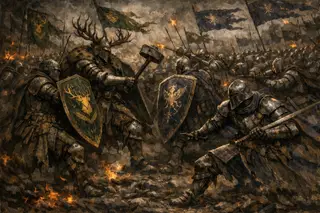
Kingdom Come did not begin with armies marching beneath banners. It began with doubt. After the Era of Creation elevated Llithe into innovation and Mana study, tension quietly grew between Bera and Reach. Malek Berathian, Duke of Reach, questioned not only his brother King Kestus’s leadership but the very philosophy of Bera’s rule. Where Bera embodied harvest, warmth, and communal stability, Reach believed in discipline, sovereignty, and controlled advancement. The ideological divide hardened into political fracture when Reach formally defected, drawing clear borders and setting the stage for what would become inevitable.
The assassination of King Kestus shattered whatever restraint remained. Struck down while traveling from a diplomatic meeting in Aeor, his death left Bera destabilized and crownless. Accusations spread rapidly, but no proof could unify the grieving kingdom. In that uncertainty, Reach mobilized. What followed was not a brief clash but a calculated, grinding campaign that stretched across six brutal years. Fields were trampled, storehouses burned, and trade routes severed. Llithe, once unified under prosperity, became a map of contested territory.
The war did not confine itself to open battlefields. It seeped into towns and forests alike. The Wisp lands saw conflict as Mana infused skirmishes scarred soil and spirit. Espionage became as vital as steel, with loyalties tested in taverns and council chambers. Oldguard hardened into an unbreakable bastion, while agricultural pillars like Farmeadow and New Harvest were fiercely defended to prevent famine. Smaller settlements suffered quietly, caught between supply demands and shifting fronts. The land itself seemed to recoil beneath the weight of constant violence.
Reach’s strategy favored endurance and precision. Supply lines were tightened. Outposts fortified. Innovation in military organization and arcane discipline allowed Reach to maintain cohesion where Bera struggled to rally without a crowned leader. Though Berathian loyalists fought valiantly and held symbolic ground, the absence of centralized authority fractured their resistance. One by one, defensive lines collapsed. By the final year, Bera’s heart remained proud but weakened, unable to sustain prolonged resistance against Reach’s structured campaign.
When Reach claimed victory, it was not marked by celebration but by consolidation. Malek took the crown, dismantling remnants of Berathian power while preserving the agricultural backbone that kept Llithe alive. Bera was not razed entirely, but reshaped into a functional capital stripped of its former sovereignty. The royal line shifted from Berathian hands to House Aurelius, ending an era and beginning another. The scars of war remained etched in stone, soil, and memory.
Kingdom Come did more than change rulers. It altered the soul of Llithe. It hardened Reach into the leading power of the realm and reduced Bera from heart to engine. It taught the kingdoms the cost of division, yet also planted seeds of quiet resentment and ideological tension that never fully faded. Decades later, even as the Era of Harmony settled into cautious peace, the memory of Kingdom Come lingered beneath every banner and border, a reminder that unity forged in blood does not easily forget how it was made.