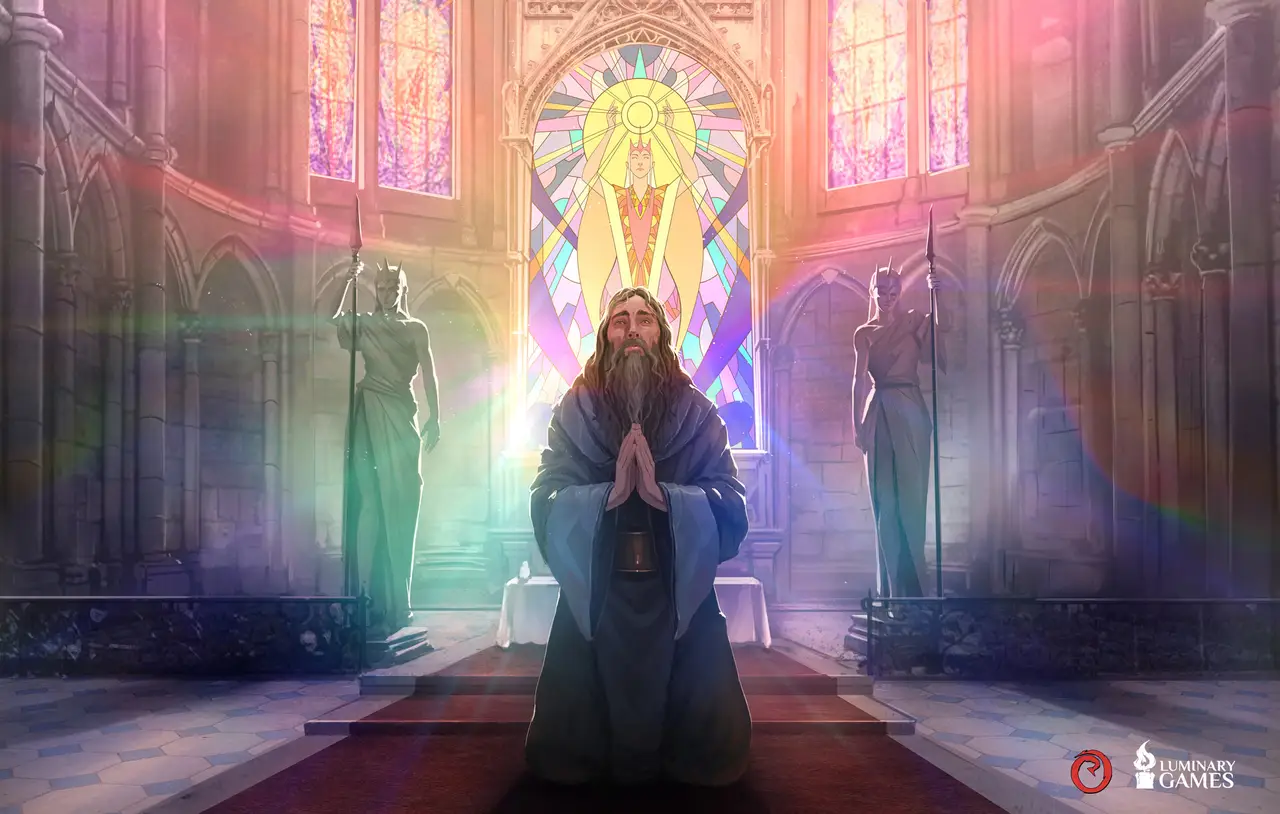
The Light of Clērātas
The Church of Clerasy is the preeminent religious and political institution of Poseia. It serves as the central spiritual authority for the realms of mankind and proclaims the worship of Clērātas, the Divine Luminary — source of truth, purifier of corruption, and eternal Light of Heaven.
Clerasy is not merely a faith, but an institution of governance. Kings are crowned beneath its blessing. Laws are sanctified by its doctrine. Armies march beneath its flame.
At its head stands the High Cleric, supreme hierarch of the Church and earthly voice of the Luminary.
I. Divine Origin and Evolution
The Chrysmerean Foundation
The roots of Clerasy lie in the ancient civilisation of Chrysmerea. There, human theologians encountered the Elven reverence of Eänyr, also called Enä, and reinterpreted this divine presence through human understanding.
From this synthesis emerged Kleiratas — later known as Clērātas — not merely as a distant celestial power, but as the Divine Light who reveals moral clarity and judges corruption.
Thus Clerasy was born from syncretism: Elven transcendence reshaped into human revelation.
The Auresian Transformation
In 2531 BF, Remes I, founder of Auresia, formalised Clerasy as the state religion of his emerging empire.
Remes declared himself the Chosen of Clērātas — the prophet-king who led humanity’s migration to Poseia under divine guidance. Through this act, theology and imperial legitimacy became inseparable.
Clerasy ceased to be merely a regional cult and became the ideological foundation of the empire.
Imperial Expansion
During the height of the Empire of Poseia, the Church expanded beyond Auresia and Reynesse, establishing bishoprics and temples throughout Cathringia and other constituent realms.
Conversion was sometimes missionary, sometimes political, often both.
By the late imperial period, Clerasy had become the dominant religious force among mankind in Poseia.
II. Doctrine and Agenda
Clerasy teaches that Clērātas is the singular Divine Luminary — the Light by which truth is revealed and falsehood exposed.
The Church operates according to three guiding principles:
1. Purity
Moral corruption is a stain that must be burned away. Sin is not merely personal failure but cosmic disorder.
2. Divine Order
Heaven has a hierarchy. So must earth. Authority descends from the Luminary through ordained channels.
3. Moral Clarity
Truth is not relative. The Light reveals what is righteous and what is heretical.
Core Objectives of the Church
Universal Alignment
All mankind must be brought into spiritual conformity beneath the Light of Clērātas.
Political Legitimacy
The divine right of kings is upheld — but only when monarchs are anointed and sanctioned by the Church. A crown without consecration lacks sacred authority.
Purification
The Church actively suppresses:
Remnants of Old Faith traditions
Heretical reinterpretations of Clērātas
The influence of the Arcane Order and unsanctioned magical doctrine
To the Church, unregulated magic is a rival authority.
III. The Hierarchy of Lumosity
The Church of Clerasy is a power unto itself. Advancement within it grants not only spiritual authority but political influence.
The Laity and Acolytes
The faithful masses and temple novices. They receive sacramental rites, healing, and instruction. Temples serve as places of lodging, refuge, and education.
Lightbearers
Consecrated warriors and exorcists of the Church.
They carry the sacred Blade of Light and act as agents of purification. In Auresian-aligned courts, Lightbearers hold political immunity and may intervene in matters of heresy or corruption.
They are both knights and inquisitors.
Illuminates
Senior clerics and scholars who govern regional branches of the Church.
They oversee doctrine, maintain theological archives, and advise monarchs. Access to restricted divine texts is reserved for their rank.
Clerics
Elite candidates for supreme leadership. They may issue ecclesiastical edicts, influence noble courts, and call for holy campaigns when necessary.
Their authority extends beyond national boundaries.
The High Cleric
The supreme hierarch of Clerasy.
Currently, this office is held by Leodis VI.
The High Cleric:
Interprets divine law
Consecrates kings
Commands Church-aligned armies
Holds the sacred artefact known as the Light of Chrysmerea
To defy the High Cleric is to risk excommunication — and political isolation.
IV. The Nature of Clerasy
Clerasy is both spiritual and imperial.
It binds scattered kingdoms into shared belief.
It crowns rulers and dethrones tyrants.
It wages war in the name of purity.
It preserves unity through doctrine.
Where Sumartism teaches covenant beneath the stars, Clerasy proclaims illumination through flame.
It is the Light that claims to stand above all others.