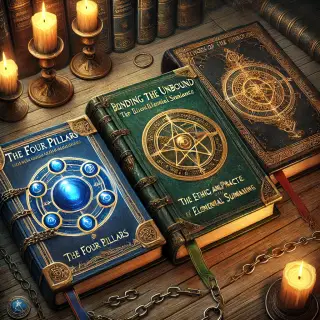
Overview of The Four Pillars: A Treatise on Elemental Balance
Author: High Arcanist Velmira, First Keeper of the Elemental Codex
Subject: The theory of elemental equilibrium, detailing how fire, water, earth, and air interact and counterbalance each other in both nature and magic.
Velmira’s The Four Pillars is considered a foundational text in elemental theory, studied by scholars, elementalists, and ritualists alike. Unlike traditional grimoires, which focus on how to wield elemental power, this treatise seeks to understand the forces at play, emphasizing the interplay of elements rather than their dominance over one another.
Central to Velmira’s philosophy is the idea that no element exists in isolation—each one is in a constant state of balance or opposition, and even in destruction, there is equilibrium. Her work challenges the conventional belief that elementals and their magic are simple, opposing forces and instead explores the subtleties of their coexistence.
Core Topics Covered
The Pillars of Creation: Fire, Water, Earth, and Air
Each element serves a distinct role in both the physical and arcane worlds.
Velmira theorizes that the interactions between these elements determine the stability of magical forces, rather than their raw strength alone.
Example: Fire does not simply destroy—it feeds on air, reduces earth to ash, and is quenched by water. It is not a force of chaos, but of transformation.
The Arcane Convergence of Elements
Certain forms of magic naturally combine elements, such as lava (fire + earth), mist (water + air), and lightning (air + fire).
Ritualists can enhance spellcasting by understanding elemental synergy, rather than treating elements as independent forces.
The Role of Ley-Lines in Elemental Balance
Velmira suggests that ley-lines are not just raw magical currents, but expressions of elemental convergence.
Disturbances in ley-lines often cause elemental imbalances, which can manifest as natural disasters or unstable arcane conditions.
The Theory of Elemental Cycles
Elements are not static forces—they shift through cycles in both nature and magic.
Example: Water can freeze into ice, then melt into a river, then rise as steam—each transformation affects the balance of the world around it.
Mastering elemental transitions can lead to greater control over advanced magic.
The Dangers of Elemental Overload
When an element grows too strong, it creates imbalance, often leading to unpredictable magical effects.
Velmira details historical events where unchecked elemental magic resulted in catastrophic ley-line disruptions.
Velmira’s Writing Style & Methodology
Deeply philosophical, blending practical magic with natural law.
Writings include first-hand accounts of elemental rituals, ley-line disruptions, and historical case studies.
Unlike other scholars, Velmira does not view elements as weapons, but as forces to be understood and respected.
Uses detailed diagrams and sigilwork, showing the balance between elements in nature, spellcraft, and ley-line mapping.
A direct excerpt from her work:
"To harness fire without knowing its need for air is folly. To control water without respecting its flow is arrogance. The Four Pillars do not fight for dominance—they shape the world through harmony and resistance alike. Only those who understand this truth can claim true mastery of elemental magic."
Tangible Benefit for Research
Arcane Equilibrium Insight: Any character who spends at least 8 hours studying the book (after deciphering the hidden runes on Velmira’s statue) gains a +2 bonus on Arcana checks related to elemental magic, ley-lines, or magical stability for the next week.
Balanced Casting: If used as a reference during an elemental spellcasting ritual, the caster may make a DC 14 Arcana check to enhance the stability of the spell, reducing the risk of arcane backlash or unpredictable elemental shifts.
Ley-Line Attunement: If a character uses this book to study an unstable ley-line, they gain advantage on any checks to analyze its state and may detect subtle imbalances that others might miss.