The Artificer Profession
Note: This is a playtest, subject to LARP Adventures Organizer edits, changes, and approval. This is a limited release that will have changes and a gradual rollout– currently, the release is for Tiers 1-4. Get excited!
An Artificer is an expert tinkerer who can leverage gems to create seemingly magical, extraordinary effects in objects they create. Though a familiar archetype in tabletop RPGs, this is a catch-all term in Osterra. In-game, they may be represented as smithies, tailors, artisans, chemists, or other focused Makers in Osterra.
Artificer is a Profession. Characters of any Main Path (Warrior, Rogue, Wizard, Healer) may take this Profession, but may only start when they are Tier 3 or higher. Though anyone can dabble, a character may only invest deeply in one Profession (except The Merchant). It likewise takes time for even established characters to earn the expertise in a specific Profession. Skills cannot be instantly bought like a character’s main or cross-Path skills, and all progression in the Profession requires in-game actions to make real.
As they build, the Artificer must bind their mastery— represented as Fusion Points— to mundane items and consume valuable Gems to make them extraordinary. Gems are a substantial rarity in Osterra, coveted by dragons, adventurers, artisans, and jewelers. They have varying levels of quality; tiny gems aren’t going to warp reality or allow you to walk on water. Likewise, it’s a waste of a fist-sized ruby to snuff out a light. An Artificer has a keen eye for Appraisal and will know how to walk this line.
As always, players should play to the spirit of the rules, which for Artificer, is to honor a Maker’s skill and create ingenious crafts-- elevation of the Game through the art you bring to events. All combinations of abilities within Artificer and Character Paths are subject to Organizer oversight.
An Artificer can come from any background, but delights in making and tinkering with things to improve them. They are defined by
Artificer Skills that temporarily create, bolster, or alter items and
Cataloging and creating Artificer Objects, powered by Gems, that bind long-lasting skill/spell-like effects to items.
Because the effects of Artificer Objects are powerful and replicate Skills and Spells in other Main Paths, the number of Artificer Objects a character can attune to is limited. While Artificer Skills do not count against this number unless stated in the Skill—they can invest effort in stronger, durable effects by creating Object Schematics and consuming Gems.
Upon entering the Profession, the character gains Fusion Points, allowing them to (1) empower their Skills (see Artificer Professional Experience below) or (2) bind spell-like effects to Artificer Objects they’ve created Object Schematics for (see Creating an Artificer Object below).
The number of Fusion points is equivalent to an Artificer’s Profession Tier at the start of an event.
In addition, most characters may only attune to one major Artificer Object at a time, but Artificers become able to attune to more Artificer Objects as they progress in the Profession through different Milestones.
Artificer Professional Experience
A Profession takes time and effort to master. In addition to slowly learning, some Artificer Tiers are gated by specific Milestones. Regardless of your Main or Subclass Tier, you will not be able to take Skills above a certain Tier unless you have fulfilled Artificer-specific special requirements.
Like Cross-Class Paths, your Tier in the Artificer Profession is the highest-skill-point ability you have in Artificer.
Like all Professions, you may not take Skills in Artificer until you are Tier 3 in your Main Path.
The Artificer must have at least one Artificer Skill in a Tier to progress to the next highest (e.g., to take a Tier 2 Artificer skill, you must have at least one Tier 1 skill).
Unlike Main Paths, an Artificer may not take more than one Artificer Skill per full event-day (regardless of Skill Points). For example, if an event is two days (a campout), an Artificer attending both days may spend Skill Points to earn [Appraise] the first day and then learn [Schematic Encryption] at the beginning of the second day. Both require in-game actions (see In-Game Progression, below)
The Artificer has specific Milestones that gate Skills. All characters may access Tier 1 and Tier 2. There are special requirements that gate access to Tier 3 and 4 skills (Artisan). Further requirements must be completed to ascend to full Mastery of the Profession (Tier 5 and 6).
Profession Focus: Though anyone can dabble, a character may only invest deeply in ONE Profession. Progressing past the first milestone means limiting (or for full Mastery, eliminating) Skills and Benefits in other Professions. The exception to this rule is the Merchant Profession– participation in the Merchant’s Guild does not limit you.
In-Game Progression
If it did not happen in-game, it did not happen.
Professions are meant to make in-person events more immersive– trading your effort at elevating the Game for unique opportunities and boons. Though Making is an art that may require actions outside of game (getting materials, assembling them into objects, investing creativity, drawing up schematics), all Artificer activities resulting in progression require an in-game component to be made ‘real’ in-game.
Non-exhaustive examples (many discussed later):
Learning a new Artificer skill (either through mentorship or Profession-driven modules)
Expending a reference material to create Artificer Schematics.
Encrypting Schematics
Performing Live Experimentation
Expending a fusion point to use a skill, imbue an object
Attuning yourself or another to an Artificer Object
Among others. Ideally, each of these are represented as scenes, modules, or interactions with at least one other Artificer and bystanders in-game, either teaching/learning. This may require coordination out of game with Artificers or even those in other Professions (Merchants, Scholars, Bards, etc.). The intention is to work together to make Osterra (in-game and out-of-game) all the better.
For some activities, there are guidelines for length and content (see, Activation of the Object below for an example). But the spirit of the rules apply. When in doubt, make sure you’re putting in effort and providing a cool experience for bystanders.
Please note: Organizers are not required to give consistent opportunities for Artificers. Players must engage with the story and seek them out, not badger Organizers or Guild Leaders for them proactively. This Profession is not intended to be linear in its growth, and whether activities count or not as progression will ultimately be up to the Artificers’ Guild and Organizers overall. Volunteering and otherwise serving the Game creates the most opportunities in this direction, but no guarantees.
Artificer Skills
Artificer Skills are one way that an Artificer can distinguish themselves. Most of these skills rely on or are empowered by their choice of [Appraise] expertise. An Artificer may take skills that have descriptors they do not have [in brackets like these], but there may be prerequisites for [Appraise] listed.
Milestone 1: Tinkerer
All characters that are eligible for the Artificer Profession (T3 in a Main Path or higher) may be Tinkerers! Tinkerers may take Tier 1 and Tier 2 Artificer Skills, but must take an [Appraise] Skill first!
For a current explanation on skills, please see the living document (at the top of this page), as skills will change during playtest.
Appraise Skills: | Gems | Runes | Weaponry | Armor | Alchemy | Constructs | Clothing | Wondrous Items |
|---|---|---|---|---|---|---|---|---|
Tier 1 | Tinkerer's Quirk | Schematic Encryption | Cooperative Action | Artorias' Silver Weapon | ||||
Tier 2 | Bypass Encryption 1 | Artificer's Wayfinder | Alchemical Concoction 1 | Weapon Warp | Alchemist's Fire |
Milestone 2: Artisan
To Progress to Artisan, a Tinkerer must…
Possess at least four unique Object Schematics they’ve created or acquired and decrypted if necessary (see Creating an Artificer Object below)
Take at least four Artificer Skills from Tier 1 and Tier 2 (at least one from each Tier). Multiple Appraise skills stack.
Create a 5-10 minute LARP scene to present at a Campout or Festival on your research or Object Schematics with an audience.
Being an artisan, you begin to stand above the others of your trade: known for your work. Perhaps you’re a smithy, an alchemist, a craftsperson, or an aspiring engineer. By taking a Tier 3+ skill in Artificer, you may only take Tier 1 and Tier 2 skills in other Professions. All Tier 3+ skills from other Professions are lost.
Tier 3 | Dedicated Artisan | Keen Eye | Craft Homunculus | Tailor's Threads | Armor Infusion | Riastrad's Magical Traps | Fabricate Harvest Guard | |
|---|---|---|---|---|---|---|---|---|
Tier 4 | Empower Homunculus | Critical Lens | Alchemical Cannon | Morphic Weapon | Alchemical Concoction 2 | Artificer Affinity | Nargrax's Unyielding Shield | Bypass Encryption 2 |
Milestone 3: Master
To Progress to Master, an Artisan must…
…wait until a future event to see the requirements! But it will include mastery of all elements of the Artificer Profession. Get out there!
Artificer Objects
Other than Artificer Skills, Artificers may instead use Fusion Points to create items of great power which simulate spells and abilities of other Paths that can last for entire events—but it requires crafting and investment to create such an item. Characters may only attune to one Artificer Object at a time, unless they have an Artificer Skill that allows for more. An Artificer may wear the Object or attune it to an ally; however, these extraordinary objects may also be looted by enemies!
To create an Artificer Object, an Artificer must possess three basic things: an object’s Materials, Schematics, and Power Source.
To see which Skills are eligible to bind to an object, see Eligible Skills/Spells to Artifice below.
The Object’s Materials – What It Looks Like
The Artificer (out-of-game and then in-game) creates and provide a relevant physical representation that is both obvious to an observer when worn and sensible given the function of the effect simulated. Examples of materials are varied and may be rings, amulets, bracelets, weapons, armor, belts, boots, or helms. When possible, an additional physical representation should reflect the requirement of a copied spell or ability (for fire resistance, a red cape and red ring worn; for extra hit points, a brown belt flag with a stripe, etc.).
For non-ruled-upon phys reps, a clearly visible object or clothing item that can be removed when expended is preferable, but should at minimum have a green ribbon to represent its [Magic] nature. Because these are powered by Gems, you might add gems to the overall appearance of the item to be consistent with its origin. There are many combinations that could be considered, and the key is to increase immersion and quality of physical representation, like any craftsman perfecting their craft.
Artificer Objects need to be Safety Checked by a Knight of the Realm or Organizer at the beginning of each event-day, before they are allowed to enter play. As Artificer celebrates Makers, the Object’s Materials should take pains to be high quality.
The Object’s Schematics – A Guide for How It Works
Next, an Artificer visually shows how the Object’s Materials works with an Object’s Schematics. Taking the Appraise Skill lends you access to creating Schematics (see Artificer Skills Tier 1, above). A Schematic is a less magical and more engineering-based version of a scroll on how to simulate a skill or spell in an Object. Remember: while this is a fantasy game, a schematic should be immersive—sketching some semi-plausible way how an Object works (i.e., “these Boots you stand on allow you to walk on water! Here’s how!”) You can also allude to how an object actually was made in an effort to increase knowledge for those curious about Making!
For Artificers, making mundane objects extraordinary requires Reference Material to simulate effects from—they are documents or live evidence of how to perform Skills or Spells. These materials are most commonly scrolls, but may manifest as runic materials, diagrams, or feats of ability from characters. An artificer can utilize these reference guides to simulate other Path’s effects by turning them into Schematics via the [Appraise] skill (see Milestone 1 – Tinkerer above). An Artificer does not need to be able to access the magical nature of the scrolls or the physical feats of abilities, but they can limitedly understand them to imbue objects with power limited by their Artificer Professional Expertise.
You may turn any one of these Reference Materials into an Object Schematic, limited by the Appraise Skill.
Scrolls: Spells equal to or lower than your Artificer’s Professional expertise. For example, if you have a 3-Skill-Point Artificer ability as your highest, you may understand a Scroll up to Tier 3—created by your character or another.
Live Experimentation: Representations of a non-magical skill-- equal to or lower than your Artificer’s Professional expertise. You or a willing ally may expend all uses of a non-magical skill for the event to roleplay demonstration. If this action has implied consequences for the character (i.e., Warrior’s Last Strike), they must be taken—they are performing the skill. If you have a 3-Skill-Point Artificer Skill as your highest, you may understand a Skill up to Tier 3, even outside your Path.
Runes, story elements, encrypted schemata, or artifacts. These are rare and subject to Organizer oversight. The costs and benefits will be defined by them.
For spells and abilities that are able to be rendered as Reference Materials, see Eligible Spells/Skills to Artifice below.
In game, an Object Schematic is physically represented by a relevant architecture diagram of sufficient creativity (build documents, ingredients and procedure, drawings of the output) requiring
A design for how the thing works in-character.
The spell or skill description it replicates + additional notes (see Eligible Skills/Spells to Artifice below)
The Tier of the effect
A label of Artificer Schematics. Possibly in addition: a symbol or wax seal to denote you made it in case it is stolen.
If encrypted (see Schematic Encryption skill, above), markings or sections that indicate this and hide info until decrypted.
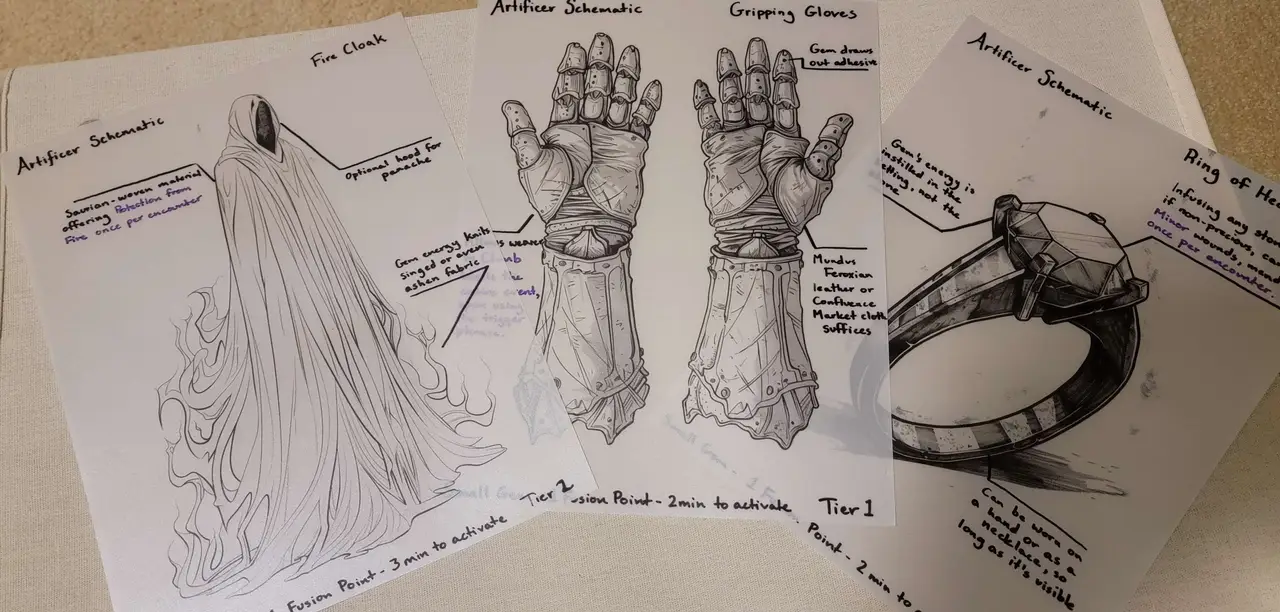
Once created, the Schematic is permanent, but doesn’t scale. If you made a Tier 2 Schematic, it doesn’t become a Tier 3 effect because you leveled up after the Schematic’s creation. You must make another of higher quality.
Some Schematics are meant to be built upon: complex architectures of multiple schemata will detail specific costs (see The Object’s Power Source, below) and benefits for undertaking a project, but it likely requires a custom physical representation that might require time between events to fabricate. It also may require specific skills or spells to realize (Locks, Wards, Traps, Fireball). It could be as simple as a magical trap to as complex as a cursed artifact, and the gem cost will be commensurate and subject to Organizer approval. Multi-step Schemata like these are typically rare and associated with Artificer milestones (see Milestone 2 – Artisan and Milestone 3 - Master, above.)
The Object’s Power Source – Giving the Object a Spark!
The Artificer weaves a gem’s energy into an object. When a gem is consumed by an Artificer or Merchant, no ‘change’ is given back. The entire gem is removed from play (returned to Organizers’ out-of-game coffers, not an in-game Artificer or Merchant’s), and any worth over the cost of building an object is lost. For this reason, an Artificer might request payment or service for their skills.
Gem Type | Tier | Approximate Value |
Tiny | 0 | 1 silver piece |
Small | 1 | 1 gold piece |
Medium | 2 | 2 gold pieces |
Large | 3 | 3 gold pieces |
Exquisite | 4 | 4 gold pieces |
Extravagant | 5 | 5 gold pieces |
Multiple lesser gems can be utilized to equate to the worth of one precious gem. For example, combining five Tiny gems (1 silver each = 1 gold) and two Small gems (1 gold) could replicate a Tier 2 ability, just like a single Medium gem (2 gold).
Though gold values are provided, these are simply guidelines for when gems are collected en masse to create Major Artifacts, support cross-Faction expenses, or as the conversion factor to Gold Dragons of the Land Game. In-game gems are worth whatever a potential trade partner is willing to pay, and you may not imbue Objects with coins—only Gems! For what Gem Types look like, see the Appendix 2 (Gem Appearance) or a Merchant dealing in Gems at events.
Activation of the Object.
While an arcanist needs to intone invocations in combat to perform magic, the Artificer has a longer method of empowering objects that takes more time but lasts longer. An Artificer must spend Fusion Points, then spend 1 minute per total worth of the gem(s) uninterrupted (but in In-Game Playing Spaces) to tinker with the resulting object, attuning to its effects.
Gem Type (or total value equivalent) | Attunement Time (at least) |
Tier 0 – Tiny | 1 minute |
Tier 1 – Small | 2 minutes |
Tier 2 – Medium | 3 minutes |
Tier 3 – Large | 4 minutes |
Tier 4 – Exquisite | 5 minutes |
Tier 5 – Extravagant | 6 minutes |
Once activated, the power is in play until exhausted—while the item can be taken off, the power source cannot be turned off, even if it is targeting no one with its benefits. This Object becomes In-Game. It no longer needs Fusion Points or Gems if taken by others. It is prioritized higher than coin when Pickpocketed or Looted, but cannot be used immediately by the thief (see Object Transfer – Foes, below).
To use the Object, your character has a drastically shortened incantation-- you must intone slightly louder than speaking voice: “Power of the [Object]: [name of the ability / description].” For example: “Power of the Ring: Iron Will!” Players should complete this intonation at least at the beginning of the next in-game encounter, so it is seen and understood by fellow players. Taking pains to hide that your character is utilizing an empowered Object is not in the spirit of the Game.
Eligible Skills/Spells to Artifice
Many, but not all, spells and abilities are able to be bound to an Artificer Object with Gems and Fusion Points. The following abilities, modified with Comments, are eligible to be emulated. For the purposes of this game, the length of an encounter is until a scene-change or 5 minutes in-game, whichever is sooner.
Ability/Spell | Gem Cost | Fusion Points | How it differs from standard ability (otherwise, follow the ability’s rules from the Skill Path). |
Tiny | 1 | Can be used indefinitely, but it takes 5 seconds between uses. The object stands in as a bandage phys rep. | |
Tiny + | 1 | Can be used once per person per encounter, but the amount you can loot varies by how powerful the Gem. | |
Small | 1 | Must be announced when using, but otherwise persists the entire event. | |
Small | 1 | May intone “Power of the [object]: Heal Minor!” to activate this 1/encounter | |
Small | 1 | May intone “Power of the [object]: Detect Poison!” to activate this 1/encounter | |
Small | 1 | May intone “Power of the [object]: Detect Disease!” to activate this 1/encounter | |
Small | 1 | May intone “Power of the [object]: Console!” to activate this 1/encounter | |
Small | 1 | May intone “Power of the [object]: Repair Minor!” to activate this spell 1/encounter | |
Small | 1 | Buff lost on death, but recharges each new encounter you wear the object and audibly activate it. | |
Small | 1 | Buff lost on death, but recharges each new encounter you wear the object and audibly activate it. | |
Medium | 1 | Can be used indefinitely, but needs announcement at the beginning of each encounter. | |
Medium | 1 | May intone “Power of the [object]: Heal Major!” to activate this 1/encounter | |
Medium | 1 | May intone “Power of the [object]: Cure Poison!” to activate this 1/encounter. May be used reactively when poison effects begin. | |
Comprehend Languages | Medium | 1 | May intone “Power of the [object]: Comprehend Languages!” to activate this 1/encounter |
Medium | 1 | May intone “Power of the [object]: Protection from Fire!” to access the spell 1/encounter. The object is the stand-in for the cape but should look thematically appropriate. | |
Medium | 1 | May intone “Power of the [object]: Protection from Fire!” to access the spell 1/encounter. The object is the stand-in for the cape but should look thematically appropriate. | |
Large | 1 | Buff lost on death, but recharges each new encounter you wear the object and audibly activate it. | |
Large | 1 | May intone “Power of the [object]: Speed Recovery!” to activate this 1/encounter after being healed by a Healer. | |
Large | 1 | May intone “Power of the [object]: Iron Will!” to activate this 1/encounter within 5 seconds of being inflicted with fear. | |
Large+ | 1 | Injects one specific poison per day (written on the Schematic) with the worth of the gem increasing based on the Tier of the Poison. [Use Poison] rules apply; those without it are poisoned trying to use it. With each Gem size greater than Large, the effect’s Tier increases by 1. | |
Large | 1 | May intone “Power of the [object]: Track Target!” to activate this 1/encounter | |
Large | 1 | May intone “Power of the [object]: Bind!” to activate this 1/encounter. Those bound should hold the item. If you are not holding the item as well and the person utilizes a [Slip Bonds] power, they can technically take the Object. | |
Large | 1 | May intone “Power of the [object]: Repair Major!” to activate this spell 1/encounter | |
Large | 2 | Buff lost on death, but recharges each new encounter you wear the object and audibly activate it. | |
Large | 1 | May intone “Power of the [object]: Speak Language!” to activate this 1/encounter | |
Large | 1 | May intone “Power of the [object]: Magic Missile to activate this 1/encounter | |
Exquisite | 2 | May intone “Power of the [object]” to activate this 1/encounter, then take up to three steps and say “Mighty Blow!” | |
Exquisite | 2 | May intone when being mortally wounded or killed: “Power of the [object]: Last Strike!” to activate this 1/encounter. | |
Exquisite | 1 | May intone “Power of the [object]: Conceal Item!” to be able to conceal 1 item per day. | |
Exquisite | 2 | Buff lost on death, but recharges each new encounter you wear the object and audibly activate it. | |
Exquisite | 2 | May intone “Power of the [object]: Lightning Bolt!” to activate this 1/encounter |
Organizers may adapt these at any time if they appear to unduly affect Game Balance.
Remember: a character may only be attuned to a single one of these Objects at a time—unless they are a sufficiently high level in the Artificer Profession. If they are not attuned, simply wearing the Object does nothing.
Accessing a spell indicates the character must cast it in a way generally recognized by other players. For example, having an item that, when activated, summons a Lightning Bolt means you need to have a LARP-safe spellball phys rep for Lightning Bolt to use it.
Exhausting the Object’s Power Source.
Eventually, the Object will expend its remaining power and become mundane again (at latest, the end of an event). In order to restore the object to its Artificer-boosted state, another power source in the form of gems is required, as well as the presence of the Object Schematics and Fusion Points. Few power sources in Osterra are infinite without attracting extraplanar attention!
If not otherwise stated, all Artificer Objects exhaust their power at the end of an event, and Object Schematics must be consulted to empower them again with Gems at future events.
Object Transfer
Artificers don’t just improve themselves. Through the physical representations they make and imbue, they can empower other characters: friends or foes!
Friends
Other characters may use and benefit from an Artificer’s ingenuity by participating in the attunement, tinkering with the object themselves. If an Artificer guides someone else, the Artificer may attune their Friend to the item instead in the same amount of time. The Artificer must explain the rules of the item to the Friend during this time. Similar effects to other spells do not stack. Finally, a Friend may only attune to one Artificer item at a time, unless they are a sufficiently skilled Artificer.
Foes
Once activated, Artificer Objects are in play and can be taken. If a character wearing one is Looted or Pickpocketed by a Rogue, these physical representations are prioritized to be given up, second only to Story Items, Artifacts, or Familiar Eggs. Schematics are next in line. The exception is if the item is considered Concealed, per the Rogue Skill. As a reminder, a dead character will not remember who has stolen from them after their death or five minutes prior to it.
A pickpocketed item must be removed from play and brought to a GM or Merchant Stand (with explanation of the item) with the clothespin at first opportunity to be picked up anonymously by the thief.
Out-of-character, the Artificer will surrender the phys rep(s) and explain the effects, as well as the caveat that, without Professional expertise, it takes 60 minutes of uninterrupted time in-play to convert the attunement from the original Artificer to the new owner. The Foe may reduce this time by consulting another Artificer who has the same or greater level of Artificer Professional Experience, who may attune it to someone else as though they are Friends by expending the relevant amount of Fusion Points. Similar effects to other spells do not stack. Finally, a Foe may only attune to one Artificer Object at a time, unless they have the Dedicated Artisan or Master of Artifice Skills.
As always, players should play to the spirit of the rules, which for Artificer, is to honor a Maker’s skill and create ingenious crafts-- elevation of the Game through the art you bring to events. All combinations of abilities within Artificer and Character Paths are subject to Organizer oversight.