Shikhet
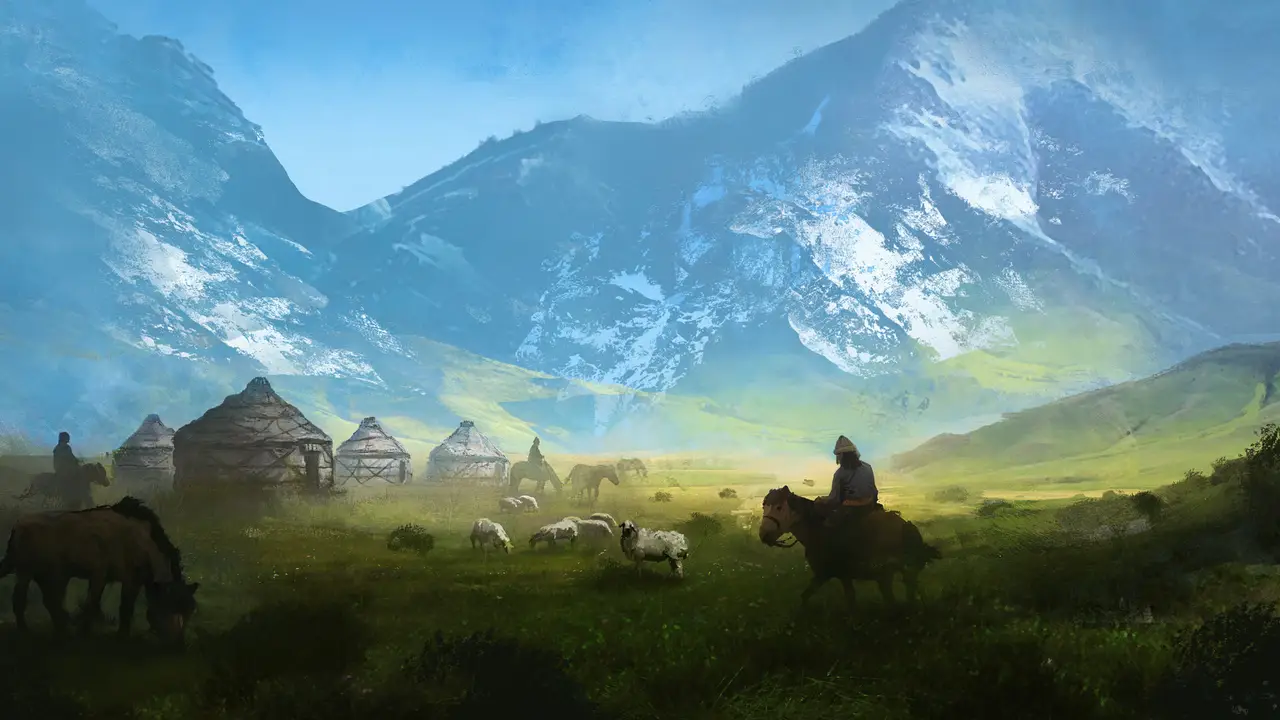
A small, village on an open plain perfect for nomad riders. It is close to the Tian shi and Valon-Vidarian border.
"Shi" can have various translations depending on the context. In Chinese, it can mean "city," "market," "rock," "stone," or "history," among other meanings.
"Khet" can have various meanings depending on the context and the language it is derived from. In Ancient Egyptian, "Khet" refers to the hieroglyphic symbol for "field" or "estate," representing agricultural land. In modern times, "Khet" is also a term used in various languages, including Hindi and Urdu, where it means "area" or "region."
Description
Nestled amidst the undulating waves of the nomadic steppe, Shikhet, a modest village of the Vidarian Khanate, emerges like a resilient oasis. Yurts, adorned with vibrant fabrics and sturdy wooden structures, dot the landscape, their circular arrangement within a protective palisade reflecting the pragmatic wisdom of the nomads. Here, the rhythmic symphony of Vidarian horses' hooves on the earth blends with the laughter of children and the hum of communal life. Amidst the changing seasons, Shikhet transforms, vibrant festivals echoing the nomads' deep connection to their ancestral traditions. A communal meeting space at its heart serves as the nexus of decisions, overseen by a trusted bey appointed by Vidar Khan, emphasizing unity in the face of the unpredictable expanse of the nomadic steppe. Shikhet, though small, stands tall as a testament to the enduring spirit of the Vidarian Khanate.
Info:
The village is made up of the Merghit and Arghan Tribal nomads. Commissioned by Vidar Khan, the village serves as a waypoint for travelers and traders. It lies on the trade route from Chugol and as a border town near the borders of Valon.