Whilst there are a few sentient species present in the Southern Reaches , all encountered so far have been either been hostile or uninterested in working with Expeditionary Coalition forces barring the Warforged.
Unique presences
Thri-kreen
Scouts have spotted several mounds in the badlands inhabited by medium-sized mantisfolk. Thus far no formal contact has been made despite scout efforts. When approached the mantisfolk appear wary but non-hostile. They seemingly live fairly simple hunter-gatherer styled lives, living off the land without depopulating or overworking the surrounding ecosystem. Members of the species bear two pairs of arms, a larger upper pair that seem to primarily be used for tasks requiring more strength, such as manual labour, and a smaller more dextrous pair just above the waist capable of finer work, such as toolmaking. Whether they cannot speak or choose not to remains unknown. Further attempts at communication are planned
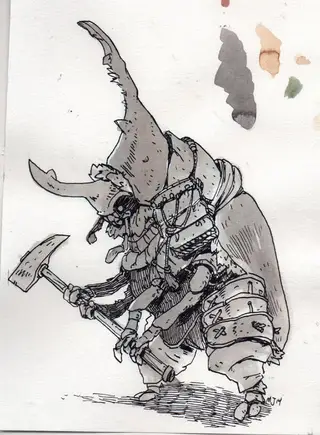
Kabutoni
In more wooded areas there have been limited sightings of large, solitary beetlefolk similar to stag or hercules beetles in terms of headshape, so far have been observed moving trees and performing limited woodworking skills. They are more humanoid shaped than many other insectfolk, with extremely humanoid arms and hands with a series of overlapping and interlocking chitinous plates. In limited circumstances they have been observed using what appear to be segments of their own shed shells as materials for tools and armour. So far have been completed disinterested in communication, and in many ways seem to have a limited intelligence. More observation and research is recommended.
Phages
A truly bizarre and unusual class of creatures, the phages are found in one place only, the labyrinthine underground of the Stonegraves. Scholars debate whether the phages are a natural evolution of some other creature or the creation of some mad fleshcrafter wizard, being a mesh of mammalian and insectile physical traits. Phages have 3 pairs of limbs, the front and rear pairs primarily concerned with locomotion, covered in chitin and made up of three segments, whilst the central pair are longer and slimmer, ending in a slim blade made of hardened keratin. Close inspection shows small flakes of metal deposited into the makeup of these sword-limbs. These limbs consist of 4 shorter sections with an extremely complex “wrist” which provides a extremely wide range of movement, which on occasion has been observed being used as a auxiliary form of movement. Unlike insects the body of phages consists solely of an abdomen, hard exoskeletal plating on the upper side gives way to softer, lightly furred flesh on the underside. This often leads to the creatures tilting their front side down, providing as much protection as possible from their target. The front side’s most obvious detail is a thin black line the runs along the rim below the exoskeleton, originally thought to be a compound eye this sensory organ is more receptive to sound and heat at short ranges. Upon vivisection, biologists found an extremely limited endoskeleton beyond a spine and the anchorpoints for tendons present in the limbs of the creature. Phages seemingly kill and eat for pleasure, or otherwise derive sustenance from an as yet unknown means.
Crocodilekin
The crocodilekin of the southwestern swamplands and bay are a decidedly neutral presence in the area. They act as a useful intermediary between the Expedition Coalition and the myriad snake- and lizardfolk on the area, lacking the almost instinctual desire for evil of the snakes and the impulsive, alien morality of the lizards. Crocodilekin have innate druidic abilities, especially regarding the influence and manipulation of plant life, often living in structures woven from living plants.
They are, however, very reluctant to leave their fellows, and uninterested in cohabiting with anything other than the snake- and lizardfolk.
Variant presences
Like seemingly every sizeable, habitable landmass, the Southlands have their own share of goblinoids. Almost immediately the Expeditionary Coalition encountered some ragtag members of various goblin tribes. A limited number of hobgoblins and bugbears have also been sighted, but typical goblin hierarchy has been subverted by the presence of some other races, typically gnolls and orcs, acting as warchiefs. The goblinoids of the Southlands seem more savage than their brethren within the Lakesht, other continents , holding no interest in industry or civilization beyond the barest necessities for pseudo-nomadic life travelling and raiding. Divisions between clans and warbands seem to be far less of point of contention, with what would typically be rival groups sometimes combining camps temporarily before separating when their mysterious goals are complete.
Gnolls in the region came as a surprise, with very few feral members of their species being present in the Duchies since unification. These gnolls propagate not through mating, but instead seemingly via a curse not dissimilar to lycanthropy. When several of the Southern Gnolls gather together for an extended period it seems to generate some kind of demonic gestalt presence. Gnolls will begin to differentiate physically, and attract hyenas to the pack. Rarely, the bodies of dead humanoids fed upon by these gnolls will undergo a perverse transformation into a gnoll over a series of days or weeks. No trace of the original person seemingly survives into this new gnoll. Similarly, hyenas that feed on corpses gnolls have partaken in also have a small chance to undergo a similar transformation. Gnolls in groups have proven universally hostile thus far, however solitary members, or those embedded in goblinoid tribes have been willing to speak or trade but have no interest in joining scouting parties in returning to The Mouth.
Flora
Glass Lilies - radiation feeding flowers of the Stonegraves
Beyonder Fungus - interdimensional mushrooms