
Varjuism
The Varjuist faith is one of the most widespread and largest religions on the continent of Nimoria. It is mainly worshipped by the khánids of Mókhenor and beyond, but smaller orcish tribes and other groups have also converted. The faithful gather often in churches, cathedral or at simple village altars to perform worship and ask for aid in their daily lives.
Beliefs
Those of the Varjuist faith believe in a single divine being, most often referred to as God. Although it has many names and many faces, such as Tengri, The Almighty, The One Above, etc. It is worshipped along with the six holy archangels and countless lesser angels of the Celestial Cohort. Many often pray take an angel as their personal protector or guide and pray only towards them. These are referred to as Guardian Angels, and any angel, no matter how low or high, can be one’s protector.
The Archangels
The six archangels are the following:
Izsten, the blessed regent, serving as the judge of all creatures in God's absence. He is most often invoked when one finds oneself in a seemingly insurmountable situation.
Minger, the divine’s judgment. He serves as the frontline against the demonic hordes of Hadúr and is the protector of all who face the evilness of the world. He is prayed to most by soldiers, knights, and paladins, as both protection and guidance in the chaos of battle
Fenzel is the helpful guide of the souls. Once a soul reaches its end, it is her job to guide them along their destined path in the afterlife. She is the guardian angel of every lost soul and of travellers.
Zágril is the holy keeper of knowledge. He is known to walk the endless expense of creation, seeking the lost knowledge of God and gathering it in his eternal library. He is the angel of knowledge and is most often prayed to by adventurers or priests.
Uriel, the greatest of healers in creation. She is tasked with the unrelenting task of healing God’s shattered body. She is prayed towards whenever plague strikes or when someone is injured, or sick.
Íngren is the manifestation of God’s glory. She is considered the most beautiful amongst all creations. She is the archangel of beauty and compassion, prayed towards for the granting of love and better looks.
Core Tenents
The Varjuist church has many teachings, but there are six that remain paramount to the lives of each and everyone of their followers. These are known as the Six Virtues, and they are the following:
Oneness: There is but one God and one God alone, whose names and appearance are as many as stars in the night sky. To go against this teaching is equivalent to going against creation itself and is greatly punishable.
Guidance: The Holy Varjuist church serves as the guiding help for the souls of this world. Without it, the people would be like an undisciplined flock of birds, flying in all directions, getting lost and hunted down. But with the church, they are united. Going against the church is going against the collective good of the world
Salvation: To achieve union with God, one must not just believe faithfully, but also show such faith through works. By helping their fellow man and vanquishing evil. For faith without works is hollow, and works without faith are meaningless.
Viaticum: Upon death, all bodies, except the ones of the living saints, are to be burned and placed in urns. To open such vessels without family or church approval, or the defilment of such sacred containers, is equivalent with coldblooded murder, and the perpetrator (s) shall be punished accordingly
Sanctum: The grounds of the church are holy; no ill intent or harm shall come to anyone undeserving of it in their halls. The brandishing of weapons or the threatening of priests and other holy workers is highly forbidden
Unity: All of creation is made by God, and so all of creation is to be considered good at first sight. To judge one without knowing one is a judgment only upon oneself alone. Yet, if one shows signs of evil, it is from that point on considered corrupt until it is brought back to salvation or dealt with.
Structure of the Church
The Varjuist church is broken up into 7 separate administrative zones, with each one having a táltos, also known as an archbishop, and a cathedral to oversee the smaller churches, abbyies and other lesser religious structures. Beneath the archbishops are the paladins, priests, and priestesses. Beneath them are the monks and nuns. And above all of them lay the supreme leader of the church, the Pontiff. They are considered the living word of God, whose speeches are law and their judgment eclipsing that of Izsten even.
Priests/Priestesses: Priests are tasked with the unforgiving job of keeping their flock of followers on the righteous path of God. They aid their local communities, listen to their sins, and give them ways to absolve themselves through faith and action. Many see these religious workers as second mothers or fathers.
Paladins: Paladins are tasked with the protection of the religious building and their upkeepers wherever they may be stationed. Their secondary job is to aid the people who attend the local rites. This can range from as menial tasks as just helping old farmers till the land here and there to hunting local magical creatures or criminals down. In short, their lives are anything but boring.
Monks/Nuns: They are the aids of priests and priestesses. They are most often tasked with copying texts, keeping their local perishes clean, and handing out alms. It is most often their job to do menial work around churches.
Táltos (Archbishop): The job of the archbishop is to oversee any and all church activities in their duchy. Other than the Pontiff themself, there is no higher power in the land than them. Upon death, their successor is chosen by the local priests. Any faithful servant of the land can be chosen as an archbishop, but almost always one of the priests of the duchy is chosen to replace the previous táltos.
Pontiff: The Pontiff is the highest position any mortal being can achieve. They are the sole interpreter of God and so serve as the highest judicial authority in the judicial and religious system. Upon death, the next Pontiff is elected with a 2/3rd majority from the archbishops. Rarely, though, the previous Pontiff wished for a chosen successor to fill his vacant position. In cases such as this, the vote only needs to be 1/3rd in favour.
Religious History
Before all, there was God. It has been there since the first breath of creation and shaped the cosmos itself into what we see today. Through countless eons of creation, he made the world and its inhabitants as we know them today. 15.000 years before our current age, God descended onto our world with his endless horde of Anoi and settled with the ancestors of the Khánid clans. For over 5.000 years, the Anoi and the Khánids lived in peace until a clan head whose name has been lost to history began to scheme. His hatred for creation and God was so strong that he was able to convince multiple fellow clan heads and even Anoi that Tengri needed to be killed. He conspired with the right hand of God, an archangel named Hadúr, and together they came up with a plan. During a festival, they will ambush the Almighty and end him, which they successfully did. The body of God was destroyed, and his mind was shattered. The War in Heaven began, and for 2.000 years it would rage on, claiming the lives of countless khánids and anoi. In the end, Hadúr was defeated, and he and his allied khánids were banished into the depths of the world, imprisoned in the molten core of the planet. The evil was banished, but not without casualties. Thousands of Anoi and loyal lhánid lay dead, God himself almost fully destroyed, its soul becoming the foundation that all magic is based upon.
With the end of the war, the Council of Archangels decided to banish the remaining khánids to prove their strength to God. They were tasked to go across the endless oceans and seas and settle in Nimoria. Once there, they are to take control of the land and upon finished with their task, they are to return to their home and conquer all lands that do not claim the Almighty as the one true God.
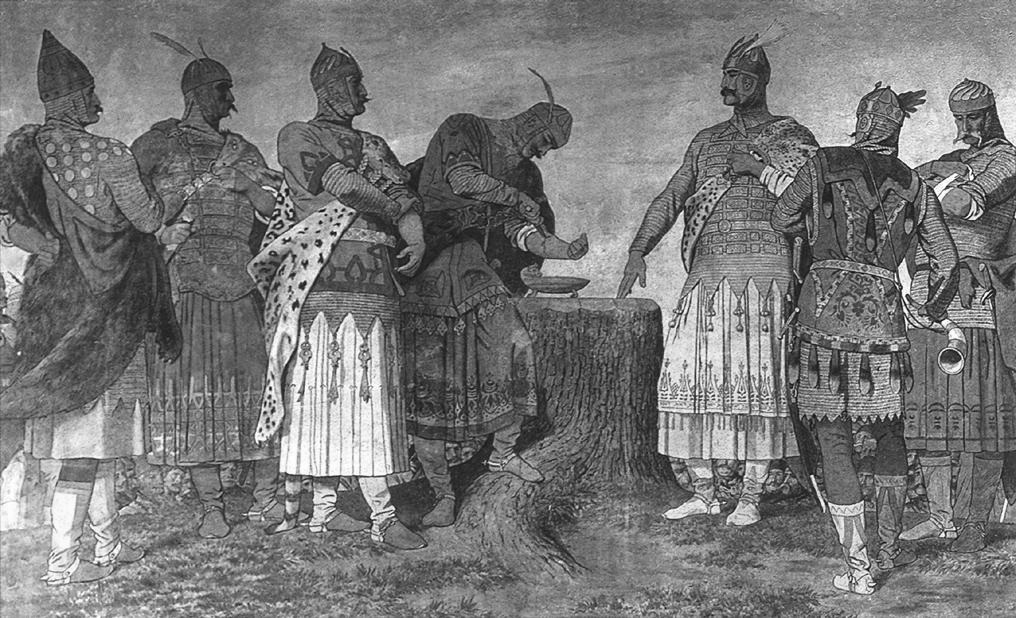
The khánids, following a clan head named Vajk, made their way across the vast expanse of water, the sea itself parting before the hooves of their horses. Once on the continent, the people built a city that they named Paradise, which was to be their capital, but soon they realised it was not to be. One day, a Turul bird carrying the remaining mind of Tengro appeared in front of a woman named Zofia. To her, the lord proclaimed that she would bear six children whom shall rule over all khánids, and one day, their descendants would rule the world from one end to another. But it said also that this can only happen if their newly found city was left to rot, leaving behind all roots to their origin. Hearing the word, Zofia spread it to the people who did not believe until she got pregnant. From this pregnancy were born twins, Ulric and Arnulf. Then another set of twins came, named Lech and Oleg. And at last, another set of twins came, named Attila and Athelsten. With the birth of the last twins, the people began to believe, but still there were doubters, and so, the archangels sent a great storm, tearing apart the capital bit by bit until none was left. And so the people left to now what is called Magna-Khánidi. Here, the children quickly grew up, and almost as soon as they reached their adult years, they began squabbling over whom shall lead the clans into this new age. To decide this, the brothers took a blood pact; whoever amongst them would bring back the greatest trophy would lead the clans united. And so they set out, all going into different corners of the vast lands of this new world. In a few weeks, they all returned and presented their games. Each brother presented their game, quickly observing that each one of the beasts had a special metallic material embedded into them, stronger and yet lighter than any the siblings had seen before. Ulric presented a cavelion, Arnulf a direwolf, Attila an elk, Lech a grait eagle, Athelsten a griffon, and at least Oleg a giant bear. With the animals presented, the brothers began to discuss who deserved to be awarded the victor, and once again, they were unable to agree, each proclaiming themself as the winner. With their business unsettled, they stormed off with their pelts and gathered for war. The bones of the animals were reforged into the Six Great Blades of the clans, and each brother took their hunted animal as their sigil.
For a millenia the brothers and their descendants warred amongst themselves to see who had the right to rule all the khánids. This conflict raged on until a man named Cush came along. It is unknown if he was a member of the six clans or if he was clanless, but nonetheless, he achieved what no one before was able to and unified the khánid clans. Afterhand he attempted to undo the clan system, proclaiming the khánids one people, under one king, and one God. This did not go well with the Grófs, and soon after his coronation, he was assassinated. His son, Nimród, declared war on his father’s killers and reunified the clans once again. Learning from his father's mistakes, he decided to keep the clans around but made them subservient to a single crown figure. He made them take a blood oath, just like their forefathers before, to uphold this law.
For the next 3.000 years, the khánids followed the Lord’s path, but slowly, in small steps, they began to stray from their written path. Their lives began to focus on unworthy subjects, and so the archangels sent down a man named Levéd to guide the khánids back to the righteous path. Sadly, with their heretical view too deeply rooted, many did not see the truth and decided to kill the messenger of God. He was nailed to a stake and set ablaze, a brutal sight to try to scare anyone from questioning the heretical beliefs. Yet as the fire raged around Levéd, he continued to pray to Tengri, and in his final moments God answered his prayers by sending a Turul bird down into the fire, delivering the proclaimer’s soul to heaven.
This sparked a great civil war, now known as the First Great Brother’s War, that lasted for three centuries, ending with the Khánid Emperor’s execution and the restoration of the Kingdom of Mókhenor, led by a man who came to be known as the second founder of the state, Sigismund. Ever since the Varjuist church, founded by the messenger Levéd himself, has never strayed from the guided holy path ahead of them, serving as one of the most important cogs in the machine that is known as the Kingdom of Mókhenor.