❝ They move with the herds, but they remember every place they’ve ever stood.
The land does not forget them either. ❞— Ishana Vel, steppe cartographer
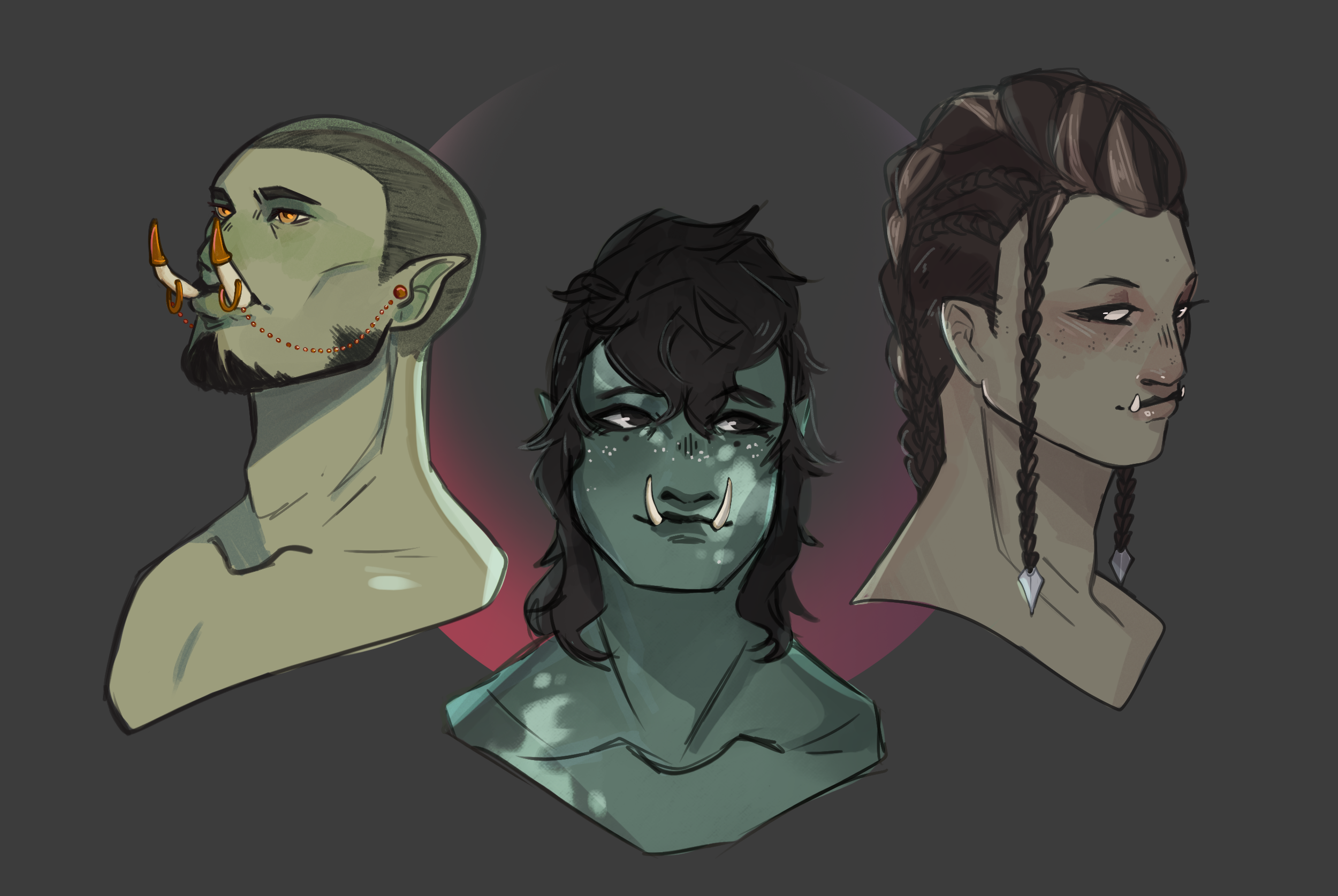
The Héroska, known in common speech as Orcs, are a Kalmet lineage whose origins lie at the intersection of myth, migration, and endurance. Their own traditions name the Vital Gods Gdarna, of Sea and Storm, and Arbn, of the Winds, as their creators, while nomadic groups of the Southwestern Steppes often revere Madag, the Visionary of Great Beasts, as their guiding progenitor.
Scholarly consensus places their divergence from other Kalmet peoples at roughly 350,000 years ago, coinciding with their arrival upon Nimoria. Whether this branching occurred through natural adaptation or divine intervention remains unresolved. By approximately 130,000 years ago, Héroska populations had stabilized into forms largely consistent with those seen today.
Once widespread across Nimoria, modern Héroska societies represent remnants of a formerly expansive and cosmopolitan presence. The Dalro of the Southern Steppes remain the most populous, maintaining nomadic traditions tied closely to great herd-beasts. Their northern cousins, the Dalar, are fewer in number but culturally diverse, shaped by the absorption of displaced hunter-gatherer groups following long periods of population decline. Coastal Ormad communities reflect yet another adaptation, shaped by maritime environments and trade.
𝐂𝐡𝐚𝐫𝐚𝐜𝐭𝐞𝐫 𝐂𝐫𝐞𝐚𝐭𝐢𝐨𝐧
Héroska are imposing in stature, typically standing between 175–220 cm at maturity, with dense bone structures and powerful musculature. Their physiques are supported by robust cardiovascular systems, including larger hearts adapted for sustained exertion. Sexual dimorphism is modest, though tusk size and curvature often serve as secondary markers of age or lineage.
Their most distinctive feature is their tusks, which develop through adolescence and generally cease growth around 18 years of age, though some individuals continue to see gradual growth well into adulthood. While tusks are believed to have been shaped primarily through sexual selection, some scholars suggest earlier functional uses in bark-stripping and plant foraging. This dietary past is echoed in their broad jaws, strong temporal muscles, and pronounced sagittal crests.
Skin tones range across muted earthen hues—deep greens, weathered tans, rich browns, and cool greys—often mottled or unevenly distributed. Scarring is common and fades slowly due to dense dermal layers. Hair is predominantly dark, from black to deep brown, with textures ranging from coarse straight strands to tight curls. Facial hair is common, and greying often appears earlier than in Humans, particularly among those exposed to prolonged hardship.
Eye coloration tends toward dark browns and blacks, with hazel appearing less frequently. Gold eyes are exceptionally rare and often carry spiritual or ancestral significance within Héroska cultures.
Héroska mature at a rate comparable to Humans and possess similar lifespans, typically living 70–80 years under favorable conditions. Their diets are heavily herbivorous, incorporating tough plant matter such as bark, supplemented by dairy and meat from domesticated bison herds. This diet reflects both ancient adaptations and modern pastoral lifeways.
Culturally, Héroska societies vary by region. Steppe groups tend toward matriarchal but non-dynastic structures, emphasizing communal authority over inherited rule. Among the Dalro, it is customary for juvenile males to be sent into exile, forming bachelor groups that may later reintegrate—or persist as independent bands. Many enduring stereotypes of Héroska “outlaws” stem from these voluntary exiles rather than from mainstream herds.