Quick Navigation
𝐕𝐈𝐈𝐈. 𝐅𝐚𝐛𝐥𝐞𝐬 𝐚𝐧𝐝 𝐅𝐨𝐥𝐤𝐥𝐨𝐫𝐞
When the heavens first formed after its separation from the earth, the first generation of kami, the Hajimekami (初め神), came into being from the mists, known only as the Three Lords of Heavenly Principles; Sei (精), Ki (氣), and Shin (神). As the architects of life, they filled both the heavens and the earth with their offspring, sculpting each kami carefully from the universe’s primordial essence. In their home of Tenkai, the Tentsukami were born, and in turn, the Koshigami were born in Koshiji.
The two factions of kami had a mutual agreement, where the Tentsukami were to rule over the skies and the Koshigami were to rule over the land and sea. This kept them in a state of equilibrium until the first creation of the yokai, who began to wreak havoc over the land and throw Koshiji into a state of eternal darkness. Seeing that the Koshigami were unable to control the chaos, the Tentsukami crossed the Sekai-no-hashi (世界の橋), the divine bridge between Tenkai and Koshiji, and sought to wage war against the Koshigami to gain governance over the earth.
While the Koshigami fought with all their might amidst the thousands of casualties, the Tentsukami ultimately won and began their reign over the world, reducing the Koshigami to little more than mere subjects of their rule. With this, the Tentsukami created new life to restore balance to Koshiji, some becoming the distant ancestors of the Imperial Family of Koushima.
Much of the scriptures related to the individual kami born during this era are lost to time as a result of being simply uncountable, illegible, or forgotten. Instead, their myths are passed down through the work of scholars and poets. What was salvageable was brought to Nimoria during the Great Exile, intertwined also with folk beliefs from Tianzhou and Hyeon, albeit with some parts missing or mistranslated.
Below are a collection of myths and legends regarding some of the most notable kami in Seishin folklore. This is not a conclusive list of kami that exist in the world.
𝐊𝐚𝐳𝐞-𝐧𝐨-ō𝐭𝐨 (風の音), 𝐭𝐡𝐞 𝐜𝐫𝐚𝐧𝐞 𝐤𝐚𝐦𝐢 𝐨𝐟 𝐰𝐢𝐧𝐝, 𝐬𝐨𝐧𝐠, 𝐚𝐧𝐝 𝐰𝐢𝐬𝐝𝐨𝐦.
Kaze-no-ōto was one of the earliest known kami to exist, having been a firsthand witness to the separation of Tenkai and Koshiji along with the Three Lords of Heavenly Principles. His name is the origin of a commonly used word to describe the sound of the wind in classical literature, symbolizing the sense of peace he always carried with him.
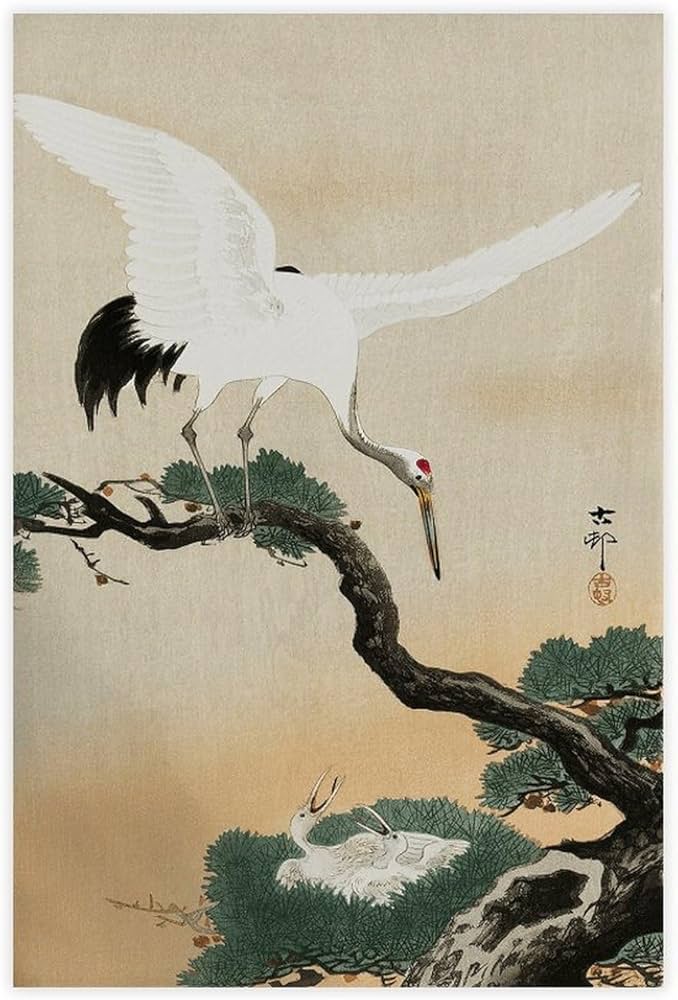
Because of his divine aspect of wisdom, he is often the mediator between the conflicts of other kami, most notably having mediated the summit between the Tentsukami and Koshigami during the transfer of power over Koshiji. He was also the creator of the first music, using the droplets of rain and whistling of leaves to create rhythm. This form of art was gifted to both ancestries and animals alike, who began to discover dance as a way to celebrate the invention of song.
Because of this, it is not uncommon to find instruments with artwork of cranes painted or engraved into them. Some, such as the gudi flute (骨笛), are carved from the wing bones of cranes, believing them to be imbued with the very same capacity for melodies as the wind kami.
Art Credit: "Crane with Nestlings in a Pine Tree" by Ohara Koson (1877–1945).
𝐑𝐚𝐢𝐤ō (雷子), 𝐭𝐡𝐞 𝐝𝐫𝐚𝐠𝐨𝐧 𝐤𝐚𝐦𝐢 𝐨𝐟 𝐭𝐡𝐮𝐧𝐝𝐞𝐫, 𝐥𝐢𝐠𝐡𝐭𝐧𝐢𝐧𝐠, 𝐚𝐧𝐝 𝐬𝐭𝐨𝐫𝐦𝐬.
Being one of the most fearsome kami, Raikō was born from the first raincloud to have graced the heavens, along with his brother, Mizujin, the kami of water. In comparison to Mizujin’s benevolence, Raikō was known for his capricious and wrathful nature. With his tail, he would slam it against the sky repeatedly like a drum to create frightening noises. With his booming voice, he would howl and cackle loudly into the air for the entire world to hear, much to their displeasure.
Mizujin, tired of his brother’s antics, asked for the assistance of Kaze-no-ōto in hopes of quelling him, believing no one else was truly as fit for the job as the master of song. Kaze-no-ōto agreed to the amusing predicament, taking flight to meet Raikō among his domain of the clouds. The crane, at first, attempted to reason with the dragon, asking that he quieted down in consideration for the other living creatures in the world. Raikō, ever defiant, only doubled his efforts, causing thunder to boom and crackle everywhere he struck.
Kaze-no-ōto anticipated this and, without losing his calm, instead sought to challenge Raikō to a duel of music and dance, seeing the kami’s penchant for both. If the crane kami won, Raikō’s storms would have to occur only while he was traveling west, and if he failed, he would retire from the skies forever. Raikō quickly agreed to this, believing his performances to be superior to that of Kaze-no-ōto.
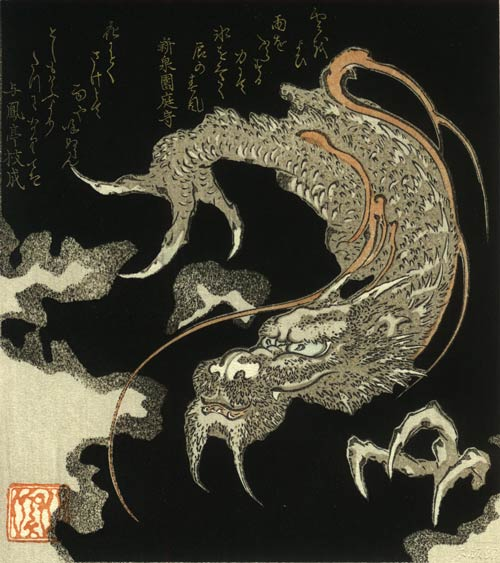
Soon enough, the two began the competition, with the dragon twisting and spinning his body in a hypnotic fashion, his thunderous drumming keeping in rhythm with the dance. To the awe of the creatures that watched the two kami, Kaze-no-ōto showed off his expert footwork, each step flowing with unearthly precision and the dew from the clouds glittering off of the crane’s elegant wings. He produced a song that told the beauty of harmony, singing of the verdant mountains and tomorrow’s winds bringing life anew. Those who bore witness to Kaze-no-ōto’s performance were brought to tears, creating a thundering applause that rivaled Raikō’s own.
Raikō, having lost, found himself confused by what fault he could have posed in the competition, gritting his sharp teeth in anger. Kaze-no-ōto simply smiled at the dragon, teaching him that his performance, while lovely, lacked balance and heart, and that it would be much improved if he took on a more sagely approach. Setting aside his pride, the dragon kami abided by the winning conditions, practicing his performance wherever he went, steering clear of the crane as he did so.
Some of his attempts would only create a gentle rumble that lulled his audience to sleep, while others roared chaotically to the dismay of others. His search for perfection still continues in the present, forever marked by his lightning strikes of frustration whenever he cannot get it right.
Art Credit: "Dragon in the Clouds" by Totoya Hokkei (1832).
𝐌𝐢𝐳𝐮𝐣𝐢𝐧 (水神), 𝐭𝐡𝐞 𝐜𝐚𝐫𝐩 𝐤𝐚𝐦𝐢 𝐨𝐟 𝐰𝐚𝐭𝐞𝐫 𝐚𝐧𝐝 𝐬𝐭𝐢𝐥𝐥𝐧𝐞𝐬𝐬.
Born from the first rainclouds with his sky-dwelling brother, Raikō, Mizujin holds domain over the water that flows through Koshiji. In some myths, it is believed that Mizujin clipped his wings on a nearby mountain rock when he fell from the sky, being the reason he cannot swim up into the heavens and join his brother. His children, who were formed from the dew that dripped from his gills, felt pity for their father and clipped their wings in solidarity, staying in the water with him and becoming the first fish to grace the seas.

Being one of the most popular kami in terms of worship, he is revered highly by fishermen, sailors, and even healers for his serenity and patience. He is generally prayed to when ensuring the availability of unpolluted water, which is often shown through the ancient tradition of raising koi fish inside of wells and gutters as a sign of water purity. Because water, as a medium of sanitation and medicine, is important to the prosperity of the people, he is also thought to be a guardian of new mothers and young children.
This is seen through the celebration of Seishōnen-no-hi (青少年の日), or Youth Day, where carp streamers are flown from the roofs of houses and iris stalks are placed in water basins to ward off impurities. More commonly, emblems of his image are displayed in clinics and seafood markets to encourage good business.
Art Credit: "Suidō Bridge and Surugadai" Utagawa Hiroshige (1857).
𝐊𝐚𝐣𝐢𝐭𝐬𝐮𝐜𝐡𝐢 (火事土), 𝐭𝐡𝐞 𝐟𝐨𝐱 𝐤𝐚𝐦𝐢 𝐨𝐟 𝐟𝐢𝐫𝐞 𝐚𝐧𝐝 𝐭𝐡𝐞 𝐤𝐢𝐭𝐜𝐡𝐞𝐧.
Kajitsuchi had her start as a hidama (火玉), a small, candle-flame sized spirit of fire. Searching for shelter from the snow, she found refuge in an old man’s irori, drawn in by the warm coals that struggled to kindle from the biting cold. When the old man returned, he noticed the hidama hiding in the hearth, kneeling down to speak with the spirit. If Kajitsuchi lit the stove and kept the house warm for him, he would cook a meal for her in return.
Wanting to survive the harsh winter, she agreed, warming the house while the old man offered warm meals to maintain her flame. The old man would occasionally leave to hunt and forage, and if he was exhausted, Kajitsuchi transformed into her fox form to help instead. Eventually, vagabonds that passed by the old man’s home were drawn in by the warmth and scent of the irori, offering good deeds of their own for a bowl of food and a place to stay. While the old man and the spirit only had each other to stave off the cold, the company that soon flooded in made them forget what it felt like to freeze, and the two began to derive great joy from the hospitality they provided.
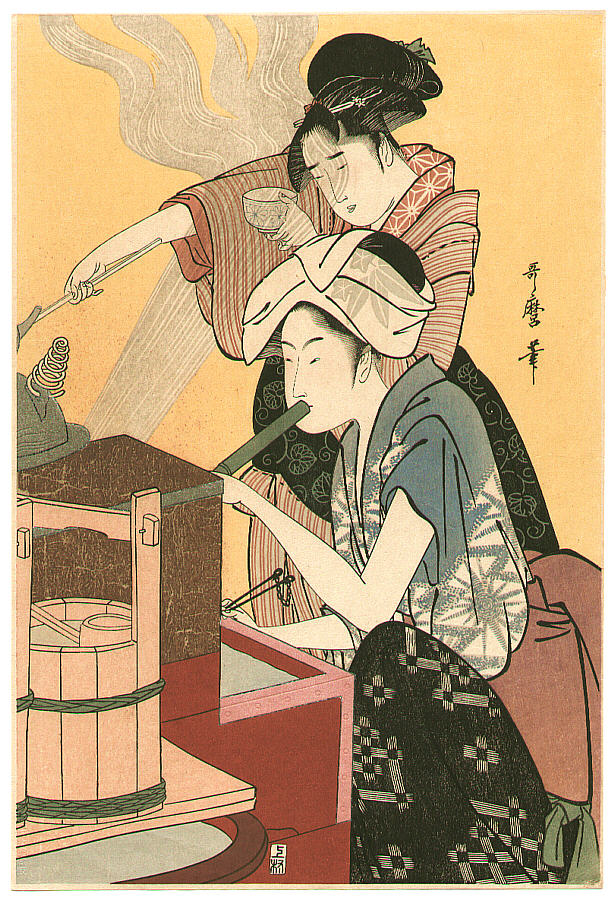
When the snow came to pass and the first flowers of spring finally bloomed, the old man passed away in his sleep with a smile, content with the life he lived in his last moments. Kajitsuchi, touched by the old man’s kindness throughout the winter, vowed to upkeep the flame of the irori, presenting herself as a fox to serve warm meals to hungry travelers who passed by her shrine.
Those who had the honor of meeting Kajitsuchi in her early days were inspired by both her soothing dishes and generosity, displaying her symbol in front of inns, taverns, and restaurants alike. She is also sometimes prayed to by blacksmiths, believing that she would help ward against fire-related injuries and accidents.
Art Credit: "In the Kitchen" Kitagawa Utamaro (1794-1795).
𝐓𝐚𝐢𝐲ō𝐡𝐢𝐦𝐞-𝐧𝐨-𝐦𝐮𝐜𝐡𝐢 (太陽姫の貴), 𝐭𝐡𝐞 𝐫𝐨𝐨𝐬𝐭𝐞𝐫 𝐤𝐚𝐦𝐢 𝐨𝐟 𝐭𝐡𝐞 𝐬𝐮𝐧, 𝐰𝐚𝐫, 𝐣𝐮𝐬𝐭𝐢𝐜𝐞, 𝐚𝐧𝐝 𝐚𝐠𝐫𝐢𝐜𝐮𝐥𝐭𝐮𝐫𝐞.
Originally the hen kami of agriculture, Taiyōhime rose to arms when the first farmlands were threatened to be decimated by Itazuragyōsha (悪戯業者), the trickster crow tengu, who gorged herself on crops and kicked up newly-planted seeds to annoy the kami.
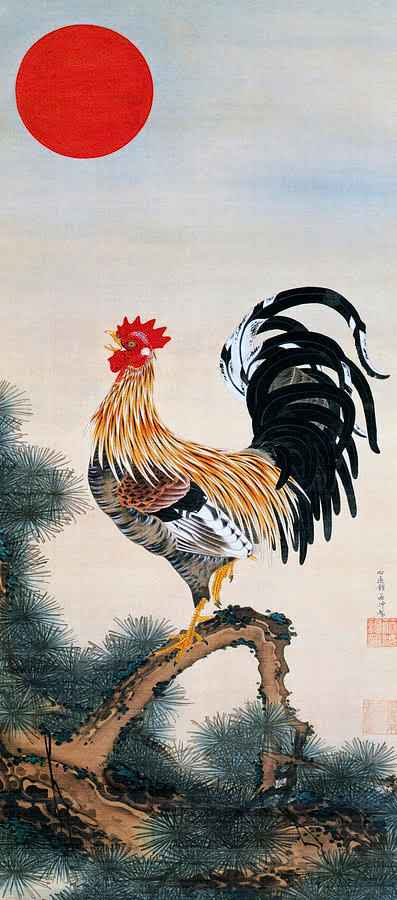
At first, Itazuragyōsha mocked Taiyōhime, believing that her lack of flight made her incapable of protecting what she sought to destroy. Enraged and determined to prove the tengu wrong, Taiyōhime soared to the highest peak of Tenkai, flying so high that the sunlight emblazoned her feathers in brilliant gold. The light that reflected off of her wings blinded Itazuragyōsha in both eyes, defeating her.
Enamoured by her strength and initiative, the tengu, whose vision was damaged beyond repair, flew to the east, where the sunlight shone the brightest, and extended a knee to Taiyōhime. Setting her pride aside, Itazuragyōsha admitted defeat to the kami, and asked for her forgiveness. Seeing the crow’s honesty, the now-rooster agreed, and as compensation for blinding her, bestowed her the honor of becoming her divine messenger to warn the mortal world of death and pestilence.
Occasionally, Itazuragyōsha gives in to her mischievous nature and scares mortals by bringing false alarms, having to fly back west to apologize to Taiyōhime after.
Art Credit: "Rooster Crowing at the Sun" Ito Jakuchu (1716–1800).
𝐓𝐬𝐮𝐤𝐢𝐦𝐨𝐧𝐨 (月者), 𝐭𝐡𝐞 𝐫𝐚𝐛𝐛𝐢𝐭 𝐤𝐚𝐦𝐢 𝐨𝐟 𝐭𝐡𝐞 𝐦𝐨𝐨𝐧, 𝐜𝐲𝐜𝐥𝐞 𝐨𝐟 𝐥𝐢𝐟𝐞, 𝐢𝐥𝐥𝐮𝐬𝐢𝐨𝐧, 𝐚𝐧𝐝 𝐥𝐨𝐯𝐞.
Before the abdication of the Koshigami, Tsukimono was a lonely kami whose intense shyness baffled even his fellow Tentsukami, only finding solace in gazing upon the quiet lands of Koshiji during the nighttime. While Tsukimono stared longingly into the darkness, he suddenly spotted a moving shadow within the once-quiet forest, revealing itself to be a humble soldier by the name of Hasu (蓮) bathing in a nearby lake.
Believing it to be love at first sight, Tsukimono snuck down from the heavens and disguised himself as a fair maiden, visiting the mortal man. From the moment Hasu laid his eyes upon the moon kami’s form, he was immediately drawn in and soon became intimate with him, lasting until Tsukimono had to slip away in the morning so as to not be seen. Because it is forbidden for kami to intermingle with the living, their relationship was kept secret from the divines, continuing for a hundred more nights.
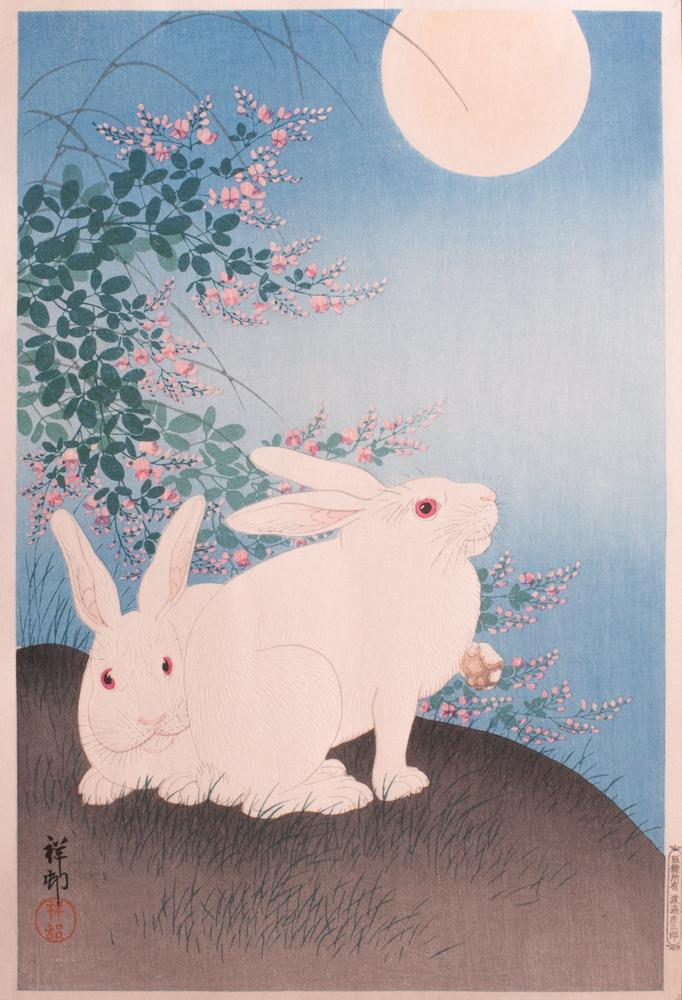
One night, the exhausted kami slept in for a little while longer, only to be awoken by the frighteningly loud coo of Taiyōhime, the kami of the sun. Deeply angered by the discovery, Taiyōhime sought to kill Hasu and Tsukimono, injuring Tsukimono in the fight that preceded after. Because of the nature of his injuries, Tsukimono was forced to unveil his disguise, revealing his true form to his lover. Hasu, petrified by shock, found himself unable to fend himself against the sun kami, getting killed as a result. Heartbroken, Tsukimono scurried away, too fast for Taiyōhime to catch up, seeking to traverse Kuraki-Michi in search of his beloved; an act so unnatural that it was unheard of.
When Hasu’s spirit crossed over into the Underworld, he found himself lost in its darkness, wasting days of travel and being stricken by a great hunger. Desperate, he found a lotus flower on the edge of the Futatsu River, the river dividing the living world from the land of the dead, consuming the seeds to sate himself. By the time Tsukimono was able to find Hasu, it was already too late as he ate the food of the underworld, meaning his soul was eternally bound to Kuraki-Michi. However, in the time that Hasu traversed the Underworld, he had come to fully accept Tsukimono in his true form, spending one last moment together.
Tearfully, Tsukimono bid his farewells to his partner, leaving him to complete his journey through Kuraki-Michi in hopes they would meet in his next life. As the moon kami returned to the lake where the two first met, he bathed himself in its waters to wash off the impurities from being in contact with the dead. Unknowingly, because Tsukimono carried traces of Hasu’s essence, the water, now imbued with supernatural potential, gave rise to creatures not meant for the land of the living. These became the yokai, the offspring of Tsukimono and Hasu’s forbidden union.
From time to time, Tsukimono finds himself yearning for the company of Hasu, and decides to make the trek from Tenkai to Kuraki-Michi as shown by the moon phases. When the moon is new, he is visiting his lover, and when it is full, he resumes his divine duties. During eclipses, Taiyōhime prevents Tsukimono from leaving his post, or even takes over for him whenever she is too late to catch him in the act.
Art Credit: "Rabbits and the Moon" Ohara Koson (1930-1931).
𝐇𝐚𝐬𝐮𝐲𝐚𝐦𝐢-𝐧𝐨-𝐌𝐢𝐤𝐨𝐭𝐨 (蓮闇の御言), 𝐭𝐡𝐞 𝐥𝐨𝐭𝐮𝐬 𝐤𝐚𝐦𝐢 𝐨𝐟 𝐝𝐞𝐚𝐭𝐡 𝐚𝐧𝐝 𝐫𝐞𝐛𝐢𝐫𝐭𝐡.
Known in life as the mortal, Hasu, the Three Lords of Heavenly Principles watched the man closely throughout his journey in Kuraki-Michi, having seen his deep devotion to the rabbit kami, Tsukimono. Before Hasu could cross the Futatsu River, the Hajimekami descended from the heavens to offer the wandering soul a deal; as long as he did not complete his journey of reincarnation, he would have the chance to see Tsukimono again. With this, they extended a cup of poisoned plum wine to him, waiting for the man to drink it to complete his vow.
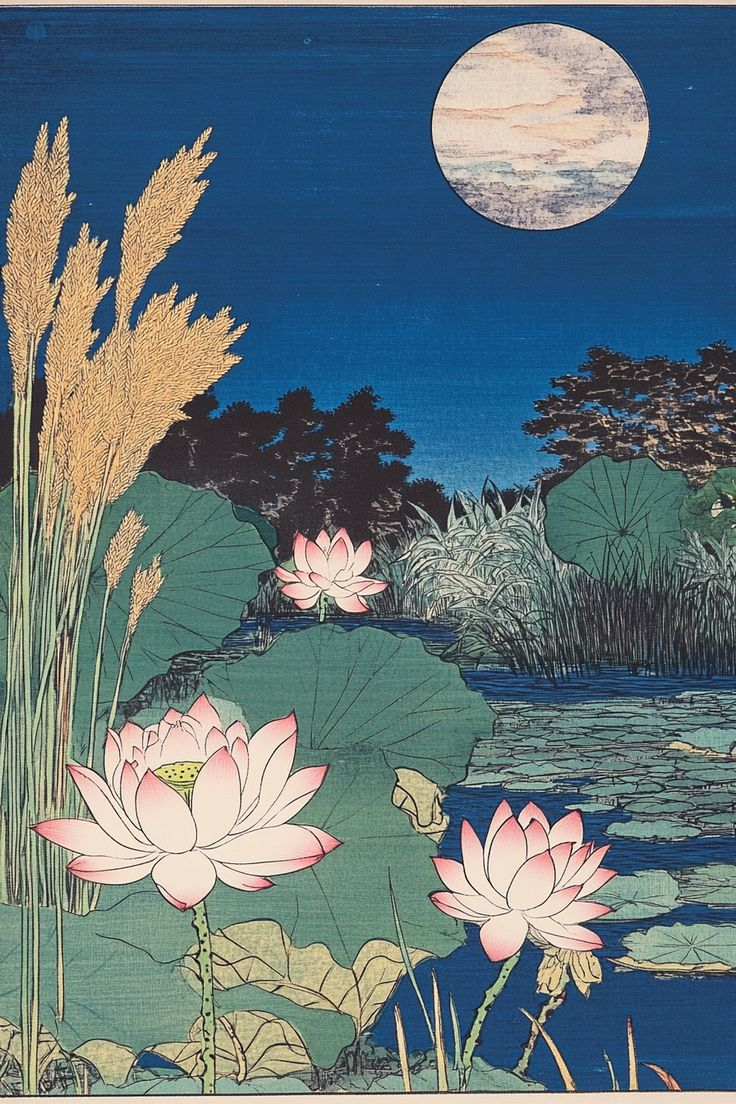
Hasu drank from the cup in agreement, and unknowing of the nature of their plans, his body soon began to rot and become infested with maggots at an accelerated rate. His agony was so unbearable that his screams caused an earthquake to split the ground apart, forever closing off the bridge connecting the spirit world to the living world. Before long, Hasu was reduced to nothing but bone, leaving behind only the lotus seeds that were digesting in his stomach. His rotten flesh became food for the seeds, blooming into hundreds upon thousands of moon lotuses in the murky darkness of Kuraki-Michi, some even making their way into Koshiji through the cracks in the ground.
After shedding his mortal skin, silk was taken from the moon lotus stems by the Three Lords, used to weave together his new form. This act marked Hasu’s ascension, aptly being given the kami name “Hasuyami-no-Mikoto”, or Hasuyami for short. He was crowned as the retainer of the underworld, in charge of guiding departed souls during their journey through Kuraki-Michi as a result of the spirit bridge’s destruction. Moon lotuses light the path to and across the Futatsu River so that the deceased will fail to get lost much like Hasuyami did.
During the approach of lunar eclipses, Tsukimono will leave the sky to visit the closed-off entrance to Kuraki-Michi, leaving offerings of Hasuyami’s favorite sweets so that he would not become homesick. In particular, this included geppei (月餅) or mooncakes, an eggwash-brushed pastry with lotus seed paste, native to the village where Hasuyami hailed from. This sparked a tradition in Seishin culture later on, where they began featuring a salted egg yolk in the middle to represent an eclipse.
Art Credit: "Dawn Moon and Water Lilies" Ohara Koson (1877-1945).